For the past few years, the narrative surrounding budget smartphones under $200 (around ₹15,000) was straightforward: democratization. Consumers grew to expect premium features like blazing-fast 5G connectivity, high-refresh-rate OLED displays, and multi-camera arrays to naturally trickle down into affordable devices.
But a harsh economic reality has brought that era to an abrupt halt. Walk into an electronics store today, and you will notice a bizarre architectural regression. Newly launched entry-level devices are ditching 5G network bands to revert to older 4G LTE chipsets. At the same time, camera counts are shrinking, and exterior designs are borrowing parts directly from 2023 supply bins.
This is the “forced premiumization” crisis. Caught in a brutal crossfire of soaring wholesale component costs and fixed consumer budgets, smartphone manufacturers are systematically dismantling the entry-level spec sheet just to keep affordable devices profitable.
The $75 Memory Nightmare: The Catalyst for Compromise
To understand why budget phones are taking a massive step backward, we have to look at the primary culprit: global semiconductor inflation.
The explosive expansion of enterprise Artificial Intelligence (AI) infrastructure has altered the manufacturing landscape. Mega-factories owned by Samsung, SK Hynix, and Micron have shifted finite silicon wafer production away from standard consumer parts to build highly lucrative High Bandwidth Memory (HBM) for AI data centers.
  [ THE COMPONENT CRISIS AT A GLANCE ]

  AI Server Demands -> Shrunk Consumer Silicon Supply
  -> Memory/RAM Component Price Surged (From ~$20 to $75+)
  -> Budget Phone Profit Margins Compressed to Zero
  -> Result: Brands must compromise on 5G, Displays, and Cameras
This sudden production vacuum has sent standard mobile component pricing into a tailspin. According to market analysts at Counterpoint Research, basic mobile memory packages that previously cost smartphone brands roughly $20 per unit have exploded to as high as $75 per unit. When memory and storage—which historically accounted for 10% to 15% of a phone’s Bill of Materials (BOM)—suddenly consume up to 40% of the entire building budget, manufacturers are left with an impossible mathematical equation.
The Strategic Retreat: Dismantling the Budget Spec Sheet
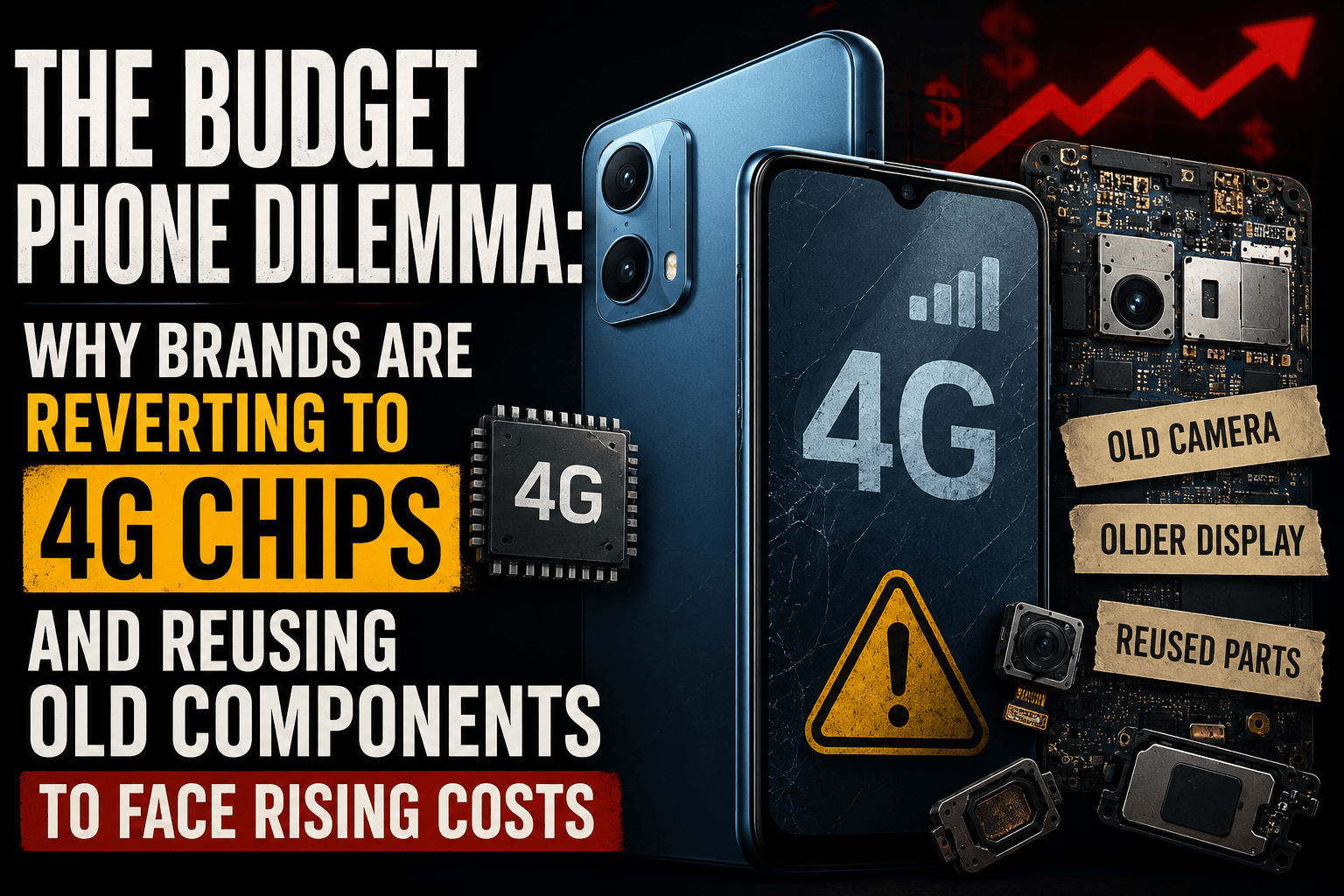
To prevent the retail prices of cheap phones from surging entirely out of reach for average consumers, brands are executing targeted hardware downgrades across three core areas:
1. Reverting from 5G to 4G Silicon
Integrating a 5G modem requires expensive licensing fees, more complex internal antenna arrays, and costlier multi-band radio frequency components. To offset the memory deficit, brands are aggressively removing 5G from their sub-$150 lineups. By reverting to older, highly optimized 4G LTE chipsets (like the MediaTek Helio G-series), manufacturers can instantly save significant capital per device while offering identical day-to-day processing performance for basic apps.
2. Microscopic Re-use (The “Frankenstein” Chassis)
Rather than designing new motherboards, lenses, or structural frames from scratch, brands are quietly dusting off older factory tooling lines.
- Teardrop Notches: Modern punch-hole display cutouts are being replaced by older, cheaper “teardrop” or “V-groove” display notches.
- Recycled Processors: It has become common practice to re-launch a 2024 device under a brand-new 2026 marketing name, introducing nothing but a fresh coat of paint on the rear plastic panel.
3. The Death of Auxiliary Cameras
The era of the “Quad-Camera” budget phone is over. Brands have realized that consumers prefer one decent sensor over four terrible ones, giving them the perfect excuse to slash manufacturing costs. Secondary wide-angle lenses and depth sensors are vanishing completely, leaving budget devices with a single primary shooter and a cosmetic blank plastic circle where a lens used to sit.
Market Realities: Entry-Level Specs vs. Margin Management
The economic impact of this component crunch highlights exactly why manufacturers have been forced to fundamentally alter their release cycles.
| Hardware Feature | The 2024 Budget Standard | The 2026 Cost-Cut Mitigation | Direct Financial Impact on the Brand |
| Network Modem | Dual-SIM Standalone 5G | Pure 4G LTE / Basic Sub-6 5G | Saves ~$15 to $20 in royalty and component licensing fees. |
| System Memory | 8GB LPDDR5 RAM Baseline | 4GB / 6GB LPDDR4X Configurations | Directly offsets the global $55 DRAM component pricing premium. |
| Display Panel | 120Hz Punch-Hole LCD/OLED | 90Hz Waterdrop-Notch LCD | Lowers panel sourcing costs by up to 30% per glass sheet. |
What This Means for Consumers
This structural shift completely changes the traditional playbook for buying an affordable phone. For the next several quarters, buying a brand-new, newly released entry-level phone might actually net you a worse technical experience than buying an older device.
If you are shopping on a strict budget, the smartest move is to look toward the refurbished, second-hand, or clearance market. High-quality devices launched a year or two ago still retain the fast UFS storage, 8GB of RAM, and true 5G modems that are currently being stripped away from factory lines. Until global memory supply chains balance out and data center demands cool down, the truest value in the tech world lies in looking slightly backward.
To see a detailed industry breakdown of this exact phenomenon, including how specific smartphone brands are handling these component rollbacks in real-time, you can check out this technical analysis on the status of budget smartphones in the current hardware market. This video provides a direct, practical look at how price hikes and internal component shifts are reshaping the entry-level retail space.