
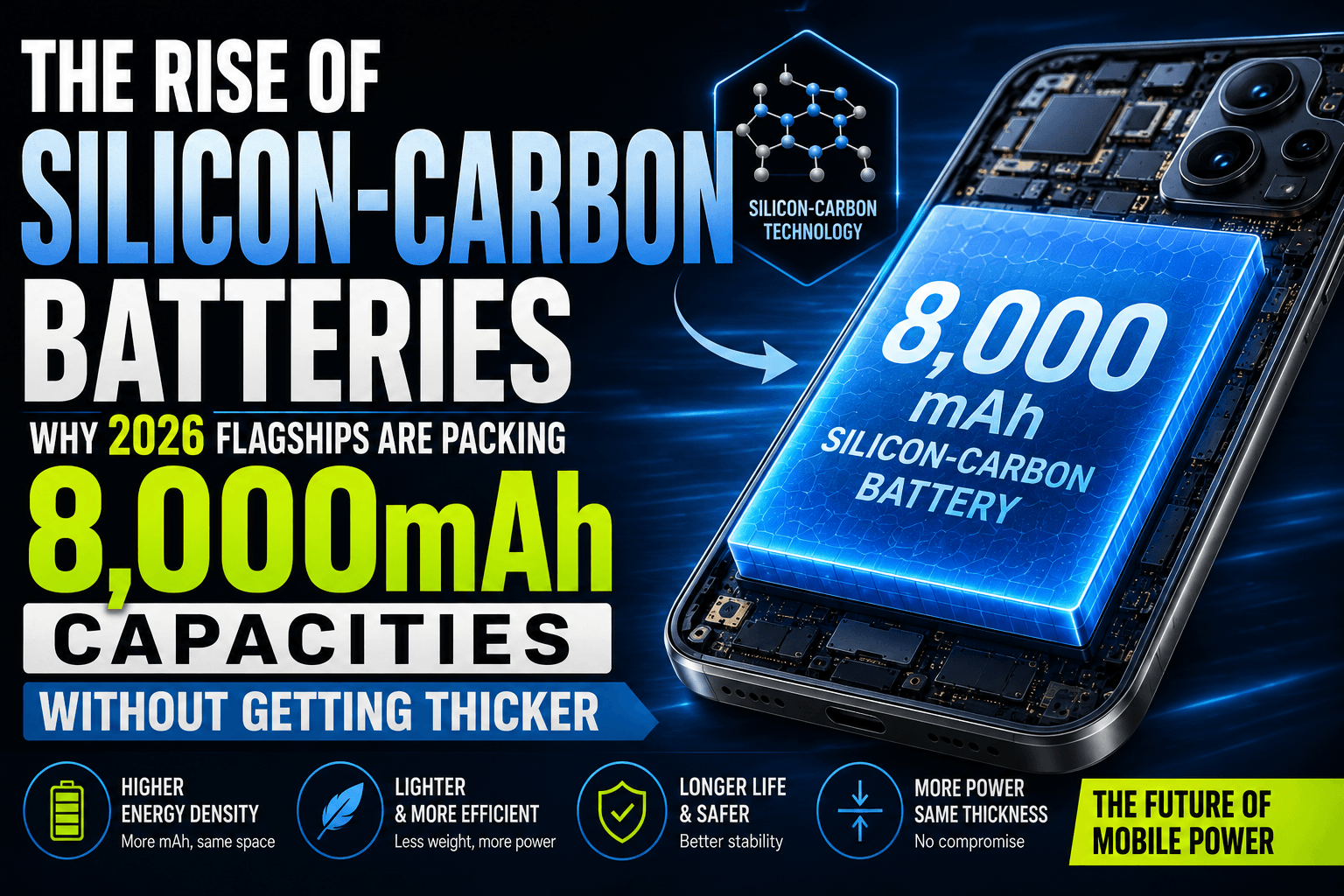
For nearly a decade, smartphone battery life felt like a solved, yet deeply compromised problem. If you wanted a phone that could easily survive two days of heavy use, you had to carry a thick, heavy “brick” that felt uncomfortable in your pocket. If you wanted a sleek, ultra-thin flagship, you had to accept a modest 4,500mAh to 5,000mAh capacity and stay close to a wall charger.
That compromise has officially ended. A massive material science paradigm shift is sweeping through the mobile industry. Devices like the newly launched iQOO 15T and the Xiaomi 17 Max are hitting the market sporting massive 8,000mAh batteries, yet their physical profiles remain astonishingly slim, hovering around the 8.2mm mark.
Android Headlines
The secret behind this sudden leap in capacity is the commercial maturation of Silicon-Carbon (Si/C) battery technology. Here is a look inside the engineering breakthrough that is rewriting the rules of mobile energy density.
The Graphite Bottleneck: Why Traditional Batteries Stalled
To understand why silicon-carbon is a game-changer, we have to look at the anatomy of the traditional Lithium-ion (Li-ion) batteries that have powered our electronics for decades.
A standard smartphone battery consists of a cathode (usually lithium cobalt oxide) and an anode. For over thirty years, graphite has been the industry-standard material for the anode. When you charge your phone, lithium ions move from the cathode and embed themselves within the layers of graphite.
BGR
While graphite is highly stable and safe, it has hit its absolute physical limit in terms of energy density—the amount of energy stored per unit of volume. To get more capacity out of a graphite battery, you physically have to make the cell larger and thicker. Because modern flagships must accommodate massive periscope camera sensors, large vapor cooling chambers, and wireless charging coils, the space left over for a graphite battery maxed out at roughly 5,000mAh.
Enter Silicon-Carbon: The Power of Anode Micro-Engineering
Silicon has long been known as the “holy grail” of battery chemistry. Compared to ordinary graphite, pure silicon can hold up to ten times more lithium ions by mass.
The Molecular Difference: In a traditional battery, it takes six carbon (graphite) atoms to bind to a single lithium ion (LiC6). Silicon transforms this ratio entirely: a single silicon atom can bind to up to 3.75 lithium ions (Li3.75Si).
By replacing graphite with a finely tuned silicon-carbon matrix, manufacturers can dramatically increase the battery’s volumetric energy density. This allows engineers to pack significantly more raw capacity into the same physical space.
KTS Cellular Malaysia
Volumetric Comparison: Traditional vs. Next-Gen Tech
| Battery Material | Average Volumetric Energy Density | Average Thickness for 5,000mAh | Scalability to 8,000mAh |
|---|---|---|---|
| Traditional Graphite Li-ion | ~650 – 700 Wh/L | 8.5mm to 9.0mm | Requires a heavy, 11mm+ “Rugged” design |
| Silicon-Carbon Hybrid (Si/C) | ~850 – 950+ Wh/L | 5.0mm to 6.0mm (Cell size) | Easily fits within an 8.2mm slim flagship |
Overcoming the “Swelling” Problem
If silicon is so inherently superior, why did it take until now to hit mainstream flagship devices? The answer lies in a destructive physical characteristic: volumetric expansion.
OPPO
When traditional pure silicon absorbs lithium ions during a charging cycle, it swells mechanically by up to 300%. When the phone discharges, the silicon shrinks back down. This continuous accordion-like flexing quickly pulverizes the silicon structure at a microscopic level, causing rapid battery degradation, internal short circuits, and a dangerous risk of swelling.
Gizmochina
To commercialize this tech, companies spent years developing a hybrid silicon-carbon composite structure.
Gizmochina
Instead of using pure sheets of silicon, engineers encapsulate microscopic silicon nanoparticles inside a highly flexible, porous carbon scaffolding. The carbon matrix acts as a protective cage, absorbing the mechanical stress and providing structural empty space for the silicon to expand and contract freely internally without increasing the external footprint of the cell. Combined with custom chemical electrolytes and advanced battery management algorithms, these cells safely survive over 800+ full charge cycles before experiencing any notable capacity decay.
Gizmochina+ 1
What 8,000mAh Means for the Everyday User
The real-world implications of this technology stretch far beyond just looking at a higher number on a specification sheet.
True Multi-Day Endurance
For the average user, an 8,000mAh battery completely changes how they interact with their device. It moves the smartphone away from “daily charging” into “multi-day” territory. Under moderate mixed use, these devices easily last three full days on a single charge. Even under a heavy, continuous enterprise or gaming workload, running out of power before bedtime becomes practically impossible.
OPPO
Offsetting the Power Hunger of On-Device AI
Modern smartphones are incredibly demanding. Flagship processors feature highly complex NPUs (Neural Processing Units) that handle generative AI features, real-time voice translation, and advanced on-device photography algorithms locally. These background processes drain significant amounts of power. Silicon-carbon technology acts as a necessary cushion, ensuring that using advanced AI tools doesn’t tank your phone’s battery life by noon.
Keeping Devices Lightweight
Historically, a high-capacity phone meant dealing with a massive wrist-straining device. Because silicon-carbon reduces the overall raw weight of the battery material required to store energy, high-end devices can hold massive capacities while keeping their total weight around an ergonomic 210 to 215 grams.
The New Standard
The era of choosing between a beautifully thin phone and a long-lasting battery is officially over. By replacing archaic graphite structures with high-density silicon-carbon matrices, material scientists have broken through the physical limitations of mobile power.
As supply chains continue to scale and manufacturing costs drop, this advanced chemistry will continue to trickle down into entry-level and mid-range devices, standardizing multi-day battery performance across the entire industry.