It is an established rule of consumer electronics: tech gets cheaper over time. Traditionally, if you buy a smartphone six months after its release, you expect to find promotional discounts, carrier price drops, or bundled deals.
However, a bizarre and frustrating counter-trend is emerging. Across the mobile industry, manufacturers are quietly raising the retail prices of existing mid-range and flagship models, reducing regional launch discounts, or introducing mid-cycle refreshes that cost significantly more than the original versions.
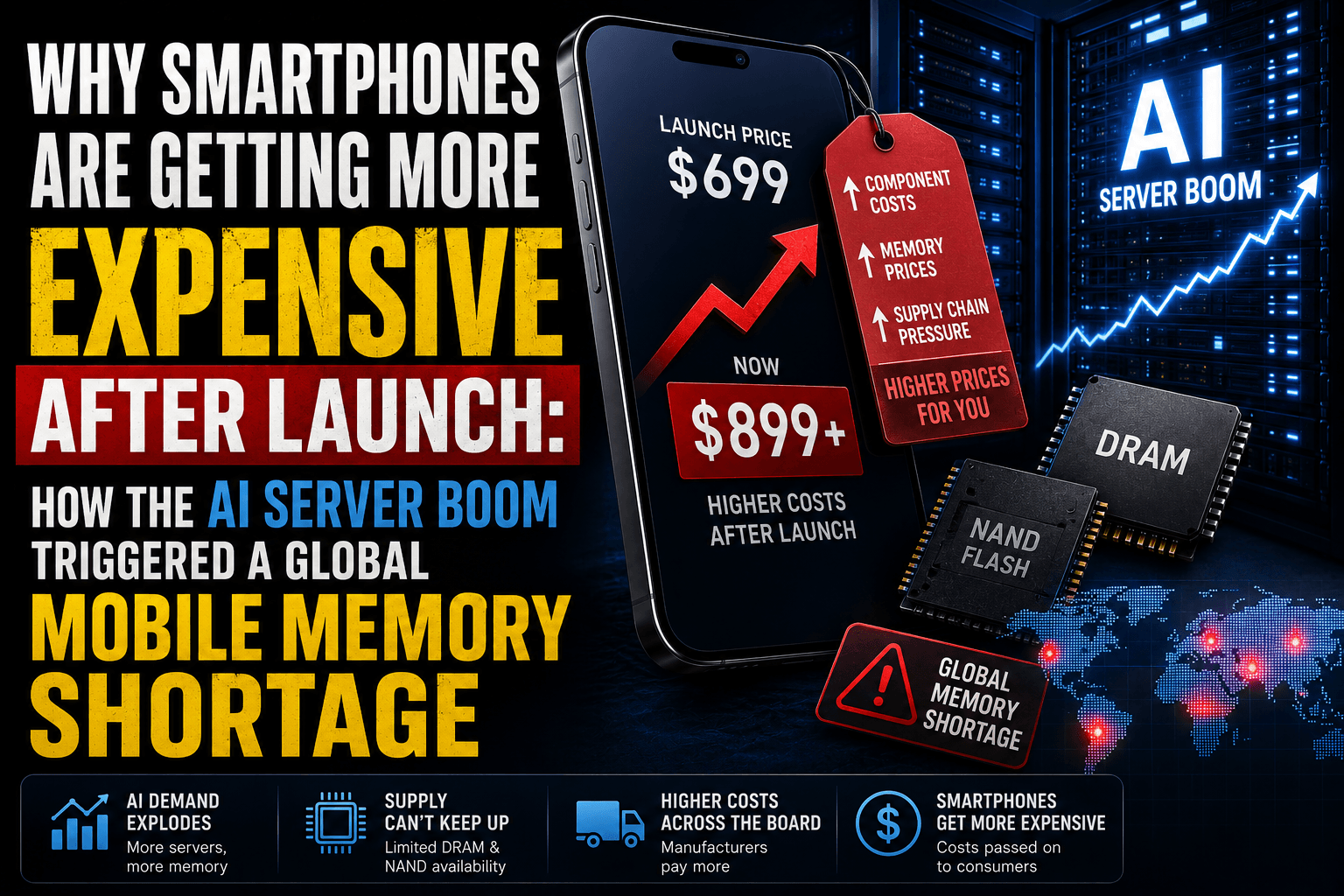
This sudden price inflation isn’t driven by standard shipping logistics or simple corporate greed. Instead, it is the direct collateral damage of a massive shift in global infrastructure: the enterprise Artificial Intelligence boom.
The hardware demand required to train massive AI models has triggered a critical global shortage of high-end mobile memory components. Here is a look inside the semiconductor supply chain to explain why the AI data center gold rush is draining your wallet at the smartphone retail counter.
The Root Cause: HBM vs. LPDDR5X
To understand how cloud servers impact a pocket-sized mobile phone, we have to look at the factories that manufacture computer memory.
A tiny handful of semiconductor giants—primarily Samsung Electronics, SK Hynix, and Micron Technology—produce the vast majority of the world’s dynamic random-access memory (DRAM). These fabrication plants (“fabs”) possess a finite amount of raw manufacturing capacity, measured in silicon wafer starts per month.
When the enterprise AI boom exploded, data center operators began purchasing every NVIDIA and AMD AI graphics processing unit (GPU) they could get their hands on. These ultra-powerful AI processors require a specialized type of ultra-fast memory called High Bandwidth Memory (HBM) to process massive language models without bottlenecking.
[ FINITE SILICON WAFER SUPPLY AT THE FAB ]
              /                      \
             v                        v
  High Bandwidth Memory (HBM)     LPDDR5X Mobile Memory
  (High Margin / AI Servers)     (Lower Margin / Smartphones)
HBM is incredibly complex to build. It requires stacking multiple DRAM dies vertically and connecting them using thousands of microscopic mires called Through-Silicon Vias (TSVs). Because HBM production is incredibly lucrative, memory manufacturers shifted huge portions of their limited production lines away from standard consumer memory to focus entirely on enterprise HBM.
This massive production pivot instantly starved the consumer tech sector, leaving smartphone manufacturers scrambling for a drastically reduced pool of high-speed mobile memory (LPDDR5X).
The Smartphone Memory Crunch: Higher Stakes in the AI Era
Compounding this manufacturing shortfall is the fact that modern smartphones actually require significantly more memory than they did just a couple of years ago.
To run complex generative AI features locally on a device—such as real-time voice translation, image manipulation, and local large language models (LLMs)—a smartphone’s chipset needs massive amounts of active, high-speed RAM.
- The Old Standard: A couple of years ago, 8GB of RAM was considered plenty for a premium Android flagship.
- The Modern Minimum: Today, running basic on-device AI algorithms efficiently requires a baseline minimum of 12GB to 16GB of LPDDR5X RAM just to keep the operating system from crashing under heavy loads.
Smartphone brands are trapped in a tight bottleneck: they are forced to pack more RAM into every single phone they build, right at the exact moment that global RAM production has been heavily scaled back to feed enterprise AI servers.
Component Pricing: The Real Cost Breakdown
The basic laws of supply and demand hit semiconductor procurement departments hard. As the mobile DRAM supply shrank, contract prices for mobile memory components began surging.
| Component Type | Estimated Component Cost Rise (Year-Over-Year) | Direct Impact on Smartphone Manufacturing |
| LPDDR5X Mobile RAM | +25% to 30% | Adds direct overhead to the base bill of materials (BOM), hitting high-tier storage configurations hardest. |
| UFS 4.0 Flash Storage | +15% to 20% | Handled by similar production fabs; drives up the base retail cost of 252GB and 512GB models. |
| Advanced System chipsets | +10% to 15% | TSMC fabrication costs passed down to brands using premium mobile silicon. |
Because semiconductor contract prices are negotiated quarterly, a smartphone brand that launched a device using memory purchased early in production faces a harsh choice when renewing component orders six months later: swallow the loss and damage their profit margins, or raise the retail cost for the consumer.
How Brands Are Hiding Post-Launch Price Hikes
Rather than publishing an aggressive press release announcing a flat price hike on an existing device, smartphone brands use subtle tactical maneuvers to offset these rising component costs.
1. Quiet Elimination of Promotions and Bundles
The most common strategy is the immediate removal of retail subsidies. Launch-day bonuses—such as free storage upgrades, complimentary wireless earbuds, or trade-in bonuses—disappear rapidly, forcing later buyers to pay full, unmitigated retail prices.
2. The Storage Component Downgrade
Some manufacturers quietly swap internal hardware mid-cycle without changing the main marketing name of the phone. A device that initially launched utilizing ultra-fast UFS 4.0 storage might see later production batches quietly downgraded to older, cheaper UFS 3.1 storage chips to preserve profit margins against rising RAM costs.
3. The “Plus” or “s” Variant Refresh
Instead of simply raising the price of an existing phone, a brand will stop manufacturing the original model entirely after six months. They replace it with a slightly tweaked version, adding a letter to the name (e.g., changing from a standard model to an “s” variant). This new version features a nearly identical feature set but launches at a permanently higher baseline retail price.
Summary: Adjusting Consumer Expectations
The global semiconductor landscape has fundamentally evolved. The phones in our pockets no longer exist in an isolated consumer electronics pipeline; they actively compete for raw silicon wafers against the trillion-dollar data centers powering global cloud intelligence.
As long as tech enterprises continue to build out AI server infrastructure at a historic pace, high-speed memory will remain a premium commodity. For consumers, this means the old strategy of waiting out a phone launch to score a deep discount is becoming less reliable. In this new market environment, securing early launch-day promotional pricing is often the smartest financial move.