
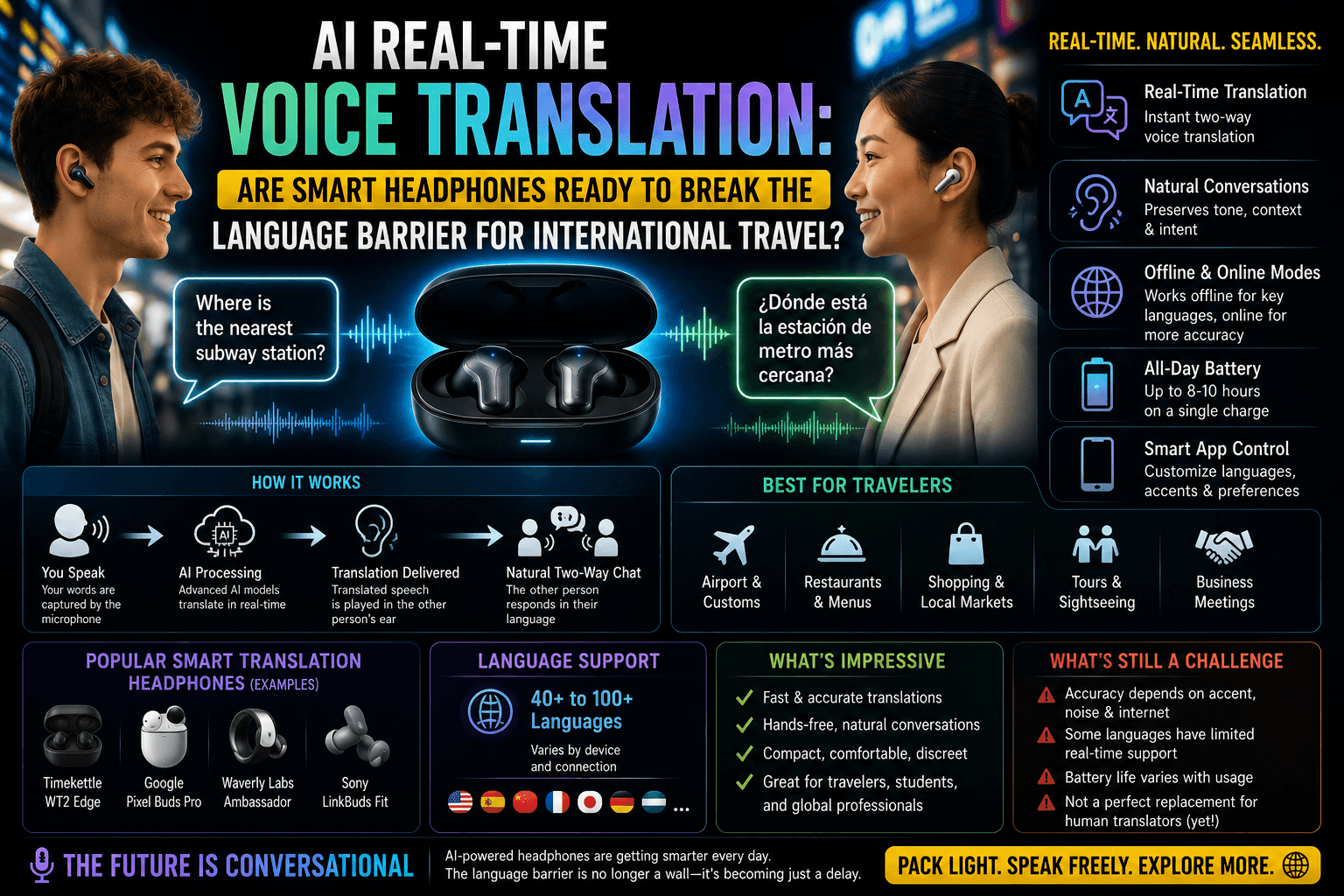
For decades, the sci-fi dream of international travel has been the “Universal Translator”—a discreet earpiece that instantly translates a foreign language into your native tongue in real time.
The integration of advanced Small Language Models (SLMs) and low-latency Bluetooth chips has turned this concept into a commercial reality. However, hardware capability varies wildly depending on your environment. While smart headphones are closer than ever to breaking the language barrier, the seamlessness of your experience depends heavily on the specific hardware ecosystem you choose.
1. The Reality Check: Latency, Accents, and the “Social Friction.”
While marketing campaigns show two strangers having a fluid, hyper-fast conversation in different languages, real-world deployment faces three distinct engineering hurdles:
- The Latency Gap: True “simultaneous interpretation” requires processing audio, converting it to text, translating the text via AI, and synthesizing a natural voice output. Premium hardware has pushed this delay down to 0.5 to 1.5 seconds. While incredibly fast, it still introduces a deliberate pause that alters the natural rhythm of human speech.
- The Ambient Noise Problem: Standard wireless earbuds utilize omnidirectional microphones that can struggle in a chaotic Moroccan bazaar or a loud Tokyo train station. Without robust environmental noise cancellation focused strictly on vocal frequencies, the translation engine can mishear words, leading to comical or frustrating translation errors.
- The Social Friction: Handing a sweaty earbud to a local stranger or taxi driver to facilitate a conversation is a massive behavioral hurdle. To combat this, the industry has split into two different hardware philosophies: Native Ecosystem Earbuds and Dedicated Translation Hardware.
2. The 2026 Competitive Landscape: Mainstream vs. Specialists
The market is split between general-purpose earbuds that leverage your phone’s native AI engine and dedicated, purpose-built translation hardware.
| Device | Type | Core Technology | Latency | Best For |
| Timekettle W4 Pro | Dedicated Interpreter | Bidirectional Simultaneous Multi-Language AI | ~0.5 – 1.0s | Extended face-to-face chats & business |
| Google Pixel Buds Pro 2 | Ecosystem Earbud | Google Translate Native API / Gemini | ~1.0s | Casual Android travelers (Auracast ready) |
| Apple AirPods Pro 3 | Ecosystem Earbud | iOS Live Translation / Translate App | ~1.2s | Seamless iPhone system integration |
| TransAI GO1 | Smart Case Hybrid | LCD Subtitle Case + App Translation | <1.0s | App-free reading & visual verification |
| Anfier M3 | Offline Specialist | Lifetime Free Offline Translation Pairs | ~1.0s | Backcountry travel without cellular data |
3. The Architecture of a Translation Exchange
To understand how these devices work in a real travel scenario, consider the operational pipeline when you use a premium, dedicated system like the Timekettle W4 Pro in One-on-One Mode:
1 . Deploy the Earbuds: Sharing the hardware.
You put on one earbud and hand the twin earbud to the local speaker. Both units remain linked to your smartphone via a dual-channel Bluetooth connection.
2.Voice Pickup & Noise Filtering: Vocal isolation.
The local speaker begins talking. earbuds’s beamforming microphone arrays isolate their voice, filtering out surrounding street or transit noise.
3. The AI Translation Loop: The Cloud/Local Handshake.
The audio data is compressed and sent to the smartphone app. The text is translated using a localized neural network or cloud engine, matching the regional accent and slang context.
4.Text-to-Speech Synthesis: Instant Playback.
The translated text is instantly converted back into natural-sounding audio and streamed directly into your earbud in your native language, achieving a near-simultaneous loop.
4. Ecosystem Features: Mainstream Standouts
If you don’t want to carry a dedicated pair of single-use translation earbuds, your everyday wireless buds have received major software upgrades:
Google Pixel Buds Pro 2 (The Android Powerhouse)
For Android users, the Pixel Buds Pro 2 operate natively with the Google Translate ecosystem. Because they tie directly into system-level controls, starting a translation routine is completely hands-free via voice commands. Furthermore, they support Auracast technology, which will eventually allow stadiums, airports, and tour guides to broadcast real-time translated audio directly to your earbuds over local wireless channels.
Apple AirPods Pro 3 (The iOS Travel Companion)
Apple’s approach leverages Live Translation embedded within the iOS system architecture. While you still utilize your iPhone’s screen as a visualizer for the other person to read, the audio routing is incredibly smooth. The AirPods Pro 3 focus heavily on auditory comfort, applying advanced voice-matching algorithms so the translated voice inside your ear sounds less robotic and matches the natural cadence of the speaker.
The Traveler’s Buying Rule: If your goal is simply asking for directions, ordering street food, or navigating train stations, your everyday AirPods or Pixel Buds paired with a smartphone screen are more than adequate. However, if you are conducting cross-border business meetings, making deep social connections, or spending hours conversing with non-native speakers, investing in a dedicated tool like the Timekettle series is mandatory to eliminate conversational friction.