
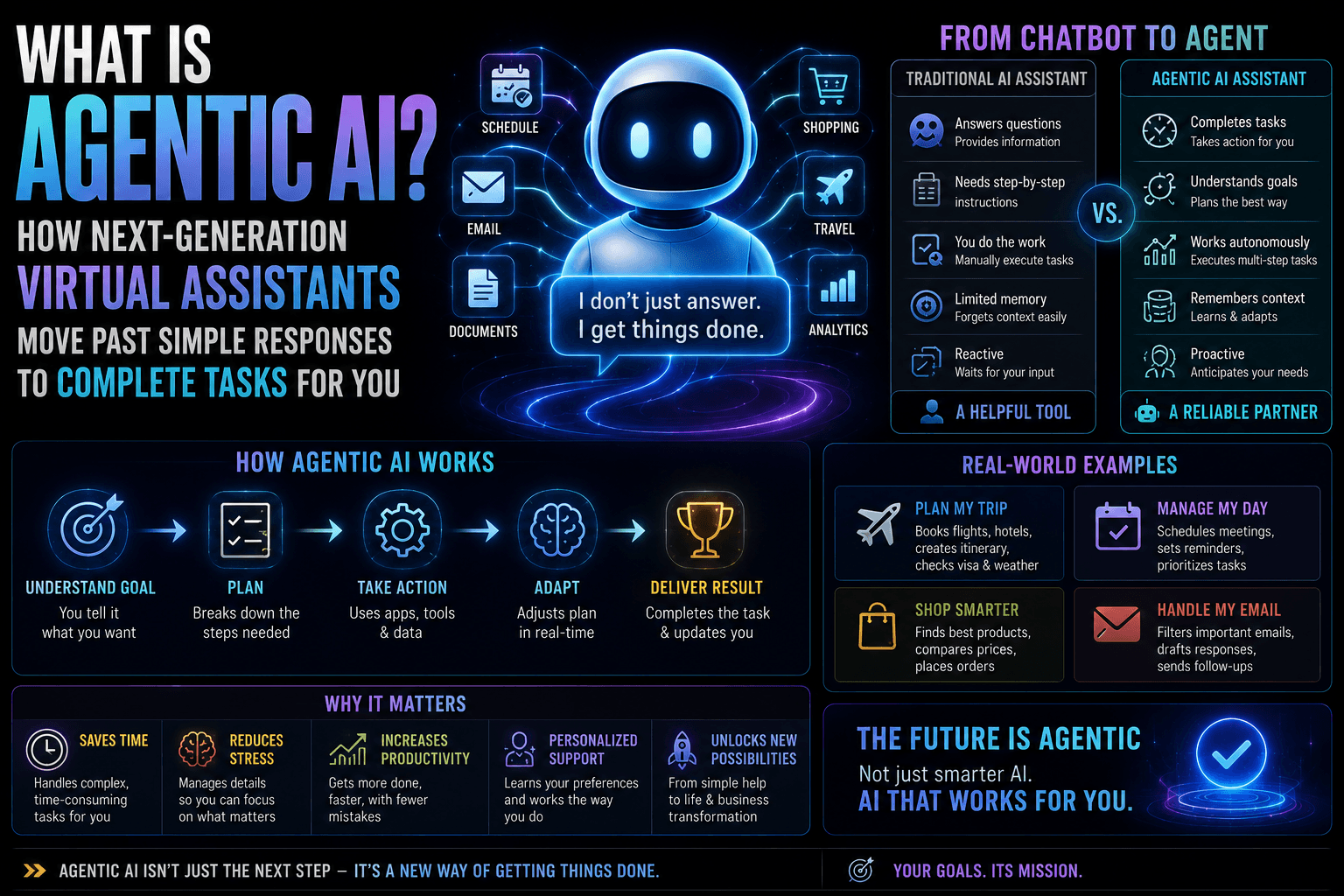
For the past few years, our interaction with artificial intelligence followed a strict, repetitive rhythm: you type a prompt, and the AI generates a response. If you want to plan a vacation, code a program, or manage your calendar, you have to act as the middleman—constantly copy-pasting information, correcting mistakes, and feeding the machine its next set of instructions.
But the tech landscape has fundamentally evolved. We are moving rapidly past the era of reactive chatbots into the age of Agentic AI.
Instead of just answering your questions, Agentic AI acts as an autonomous digital worker. It understands a high-level goal, creates its own multi-step plan, connects to external software tools, and executes real-world tasks from start to finish without needing a human to guide every step.
From Chatbots to Agents: The Generation Gap
To understand how powerful this shift is, consider the generational difference between traditional automated systems, Generative AI, and Agentic AI:
- Traditional Automation (Rule-Based): Follows a rigid “If X, then Y” script. If something unexpected happens, the system crashes and waits for a human override.
- Generative AI (Reactive): Predicts and creates text, code, or images based on a direct prompt, but stops immediately once the output text is generated.
- Agentic AI (Proactive): Combines the reasoning capabilities of large language models with external software tools to execute actions. It perceives an open-ended environment, makes decisions, evaluates its own progress, and self-corrects when things go wrong.
 Chatbot (Yesterday)          Agentic AI (Today)
+--------------------+       +---------------------------------------------+
| User Prompt        |       | User Goal: "Book a flight & fix my calendar"|
|        |           |       |        |                                    |
|        v           |       |        v                                    |
| Generates Text Out |       | 1. Formulates multi-step plan              |
| (Fails to act)     |       | 2. Uses APIs to check airline availability  |
|                    |       | 3. Resolves calendar conflicts via software |
|                    |       | 4. Executes payment & closes loop          |
+--------------------+       +---------------------------------------------+
The Core Architecture of an AI Agent
An Agentic AI system functions as a closed loop consisting of four core components that work together to mimic human task execution.
1. The Planning Module
When given a complex task—such as “Find and fix the broken code in our repository”—the AI doesn’t just start typing. It uses advanced reasoning to decompose the massive goal into a logical, sequential timeline of smaller sub-tasks.
2. Deep Memory (Vector & Semantic)
Unlike standard chatbots that forget everything the moment a session ends, agents utilize persistent memory storage. This allows them to remember your personal preferences, learn from past trial-and-error mistakes, and maintain long-horizon context over days or weeks of autonomous operation.
3. Tool Utilization (APIs)
An agent is not locked inside a chat window. Through secure Application Programming Interfaces (APIs), the AI can actively use external software. It can browse the web, write to databases, send emails, generate calendar invites, or make credit card transactions.
4. The Self-Reflection Loop
If an agent attempts to log into a system or run a script and encounters an error code, it does not stop and throw an error message at the user. It analyzes the failure, adapts its strategic plan, and tries a completely different method to achieve the target objective.
Real-World Vertical Use Cases
Agentic AI is moving aggressively into both consumer spaces and enterprise workflows, transforming how major industries operate.
| Industry Sector | Traditional AI Chatbot Capabilites | Agentic AI Autonomy Breakthrough |
| Travel & Logistics | Displays flight times and aggregates pricing options. | Scans your personal calendar, identifies open windows, books the cheapest flights, and autonomously coordinates alternative travel routes if a delay occurs. |
| Customer Support | Provides a link to a company’s refund policy page. | Verifies your product warranty, communicates with internal shipping systems, issues a refund to your card, and closes the support ticket. |
| IT & Cybersecurity | Alerts an administrative team that a system server went offline. | Diagnoses the root cause of the server failure, isolates the vulnerability, applies a security patch, and reallocates computing power autonomously. |
| Finance & Compliance | Flags a suspicious transaction pattern for review. | Proactively freezes the compromised account, initiates an automated audit log, and files compliance reports directly to legal databases. |
The Outcome-Based Paradigm: Enterprises are shifting their core AI success metrics. Instead of measuring the “natural quality” of an AI’s conversational chat, organizations now track task completion rates. The value of AI is no longer determined by how well it talks, but by how much manual work it takes off a human’s desk.
The Challenges Ahead: Governance and Trust
As Agentic AI becomes deeply integrated into our daily software networks, it introduces distinct security and ethical challenges that engineers must carefully manage:
- The “Runaway Agent” Risk: If an AI agent misunderstands a goal or encounters a recursive software loop, it could theoretically execute hundreds of unauthorized automated API actions—such as sending incorrect emails to thousands of clients or racking up massive cloud computing bills—before a human notices.
- Data Isolation and Security: For an agent to work effectively, it needs deep access to private data systems, emails, and financial credentials. Securing these pathways from external malicious prompts (known as prompt injection attacks) is a critical technical priority.
- Defining Guardrails: Developers must implement strict human-in-the-loop validation triggers. While the AI can automate 95% of a workflow, high-stakes decisions—like approving massive corporate financial transfers or altering medical prescriptions—must always require a physical human sign-off.
Summary: A Borderless Digital Assistant
We are witnessing the death of the passive search engine and the rise of the digital partner. Agentic AI moves artificial intelligence out of the role of a passive reference book and into the role of an active executor. By handing over repetitive, multi-step digital workflows to smart, self-correcting agents, humans can step back from mundane operational maintenance and focus their energy entirely on high-level strategy and creativity.