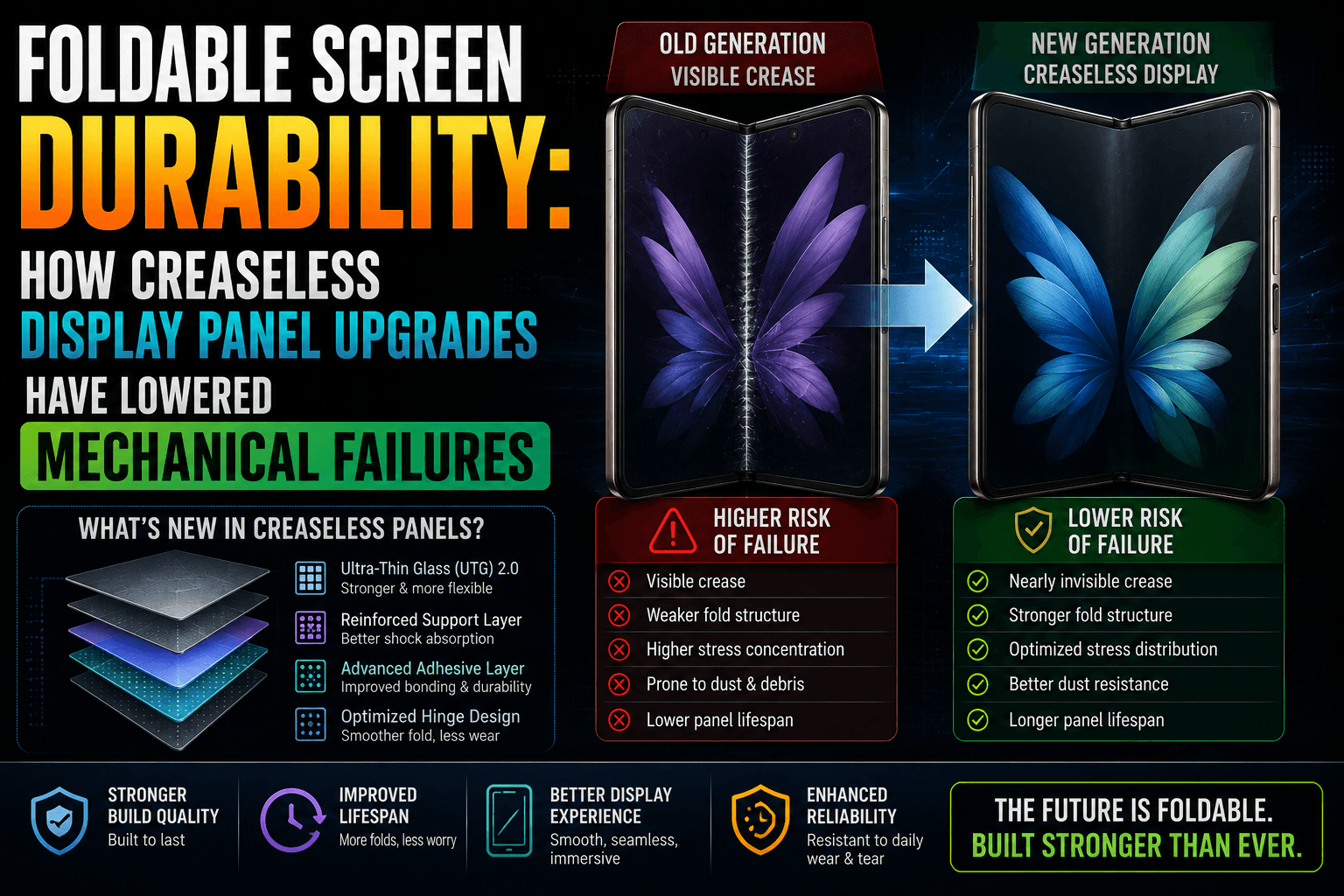
For early adopters of foldable smartphones, the primary concern was never software or performance—it was physics. The flexible display of a foldable phone is essentially a mechanical sandwich of Ultra-Thin Glass (UTG), protective polymers, and optical adhesives folded over thousands of times.
Historically, this repetitive bending motion resulted in a highly visible, physically indented center crease. More than just a cosmetic eyesore, that crease was a warning sign of mechanical vulnerability. Over time, the localized structural stress along that center line led to premature screen fatigue, micro-cracking, and dead pixels.
However, the current generation of foldables has undergone a major engineering upgrade. By shifting to creaseless display panels, manufacturers have solved the aesthetic issue while drastically reducing structural field failures.
The Mechanical Root Cause: Why Older Foldables Failed
To understand why creaseless panels are more durable, we have to look at how older flexible screens folded.
Early foldable hinges utilized a strict “U-shaped” fold design. When the device closed, the display panel was forced into a tight, sharp angle. This concentrated 100% of the mechanical bending stress onto a single, narrow line of pixels down the exact center of the screen.
OLD "U-SHAPED" HINGE              NEW "WATERDROP" HINGE
   (High Stress)                     (Stress Distributed)

     |      |                           \        /
     |  __  |                            \  __  /
     (______)                             (____)
  Tight, sharp radius                  Wide teardrop radius
This localized pressure caused severe physical wear:
- Micro-Delamination: The constant compression and stretching forced the delicate adhesive layers separating the OLED element from the UTG layer to pull apart.
- UTG Micro-Fractures: Repeated bending on a microscopic radius caused the flexible glass to develop tiny “spiderweb” fractures along the crease, eventually causing the OLED fluid to leak out (creating the dreaded black line of death).
- Debris Trapping: The deep trench of a traditional crease acted like a wedge, trapping pocket lint and dust. When the phone closed, those trapped particles were pressed directly into the screen, piercing the display from the outside in.
The Breakthroughs Eliminating the Crease—and the Stress
The elimination of the crease is the result of structural upgrades positioned directly beneath the display panel.
1. Advanced Waterdrop Hinge Geometries
Modern foldables utilize advanced teardrop (or waterdrop) hinge designs. When the phone closes, the hinge allows a section of the display to gently roll backward into a wider, hollow teardrop shape inside the body of the phone. Instead of bending the screen at a sharp 180-degree angle over a 1mm radius, the curve is spread out over a much wider area. This reduces the acute bending stress on the physical components.
2. Laser-Drilled Micro-Perforations
The most significant material breakthrough comes from advanced micro-engineering underneath the display matrix. Next-generation creaseless panels utilize a specialized metal support plate situated directly under the flexible OLED layer.
Using ultra-precise industrial lasers, manufacturers cut microscopic, specialized perforations into this metal support layer along the entire hinge zone.
The Physics of Stress Distribution: Instead of forcing the display to bend along a rigid, single axis, these laser-drilled micro-perforations allow the entire hinge section of the metal plate to flex uniformly. This spreads the mechanical bending load across a wide zone rather than letting it focus on a single line of pixels.
3. Self-Healing, Viscoelastic Adhesives
Traditional optical clear adhesives (OCA) grew brittle over time, especially when exposed to cold temperatures, leading to cracking along the fold. Modern panels use highly elastic, viscoelastic polymers. These specialized adhesives can stretch and compress millions of times without losing their grip, actively resisting the micro-separation that causes the display to bubble and lift at the crease line.
Mechanical Failure Rates: A Comparative Look
The transition to distributed-stress creaseless panels has fundamentally changed device longevity metrics across service centers.
| Failure Mode | Traditional U-Shaped Panel (With Crease) | Modern Laser-Perforated Panel (Creaseless) | Underlying Engineering Fix |
|---|---|---|---|
| Crease Micro-Cracking | High (Often occurs within 50k–100k folds) | Rare (Rated for 200k–400k+ folds) | Waterdrop hinge geometry broadens the minimum bend radius. |
| Layer Delamination (Bubbling) | Common in fluctuating temperatures | Minimised via viscoelastic polymers | Next-gen adhesives maintain flexibility in extreme hot and cold climates. |
| Debris Puncture Failures | High (Crease valley catches abrasive particles) | Low (Flat surface profile repels debris) | Internal hinge sweepers combined with a flat display plane prevent debris nesting. |
Summary: A Mature Era for Foldable Tech
The development of the creaseless display panel marks the point where foldable smartphones transitioned from experimental prototypes into reliable daily devices. By reimagining the internal physics of the fold—moving from a sharp, localized bend to a broad, distributed curve—hardware engineers have successfully eliminated the primary point of failure. For consumers, this means choosing a foldable no longer requires compromising on long-term hardware durability.
To see a real-world demonstration of how these structural improvements hold up under extreme stress testing, check out this durability breakdown showing how manufacturers test flexible screen stress limits. This video gives you a front-row seat to the robotic testing rigs that open, close, and impact these new creaseless panels to prove their real-world structural integrity.