
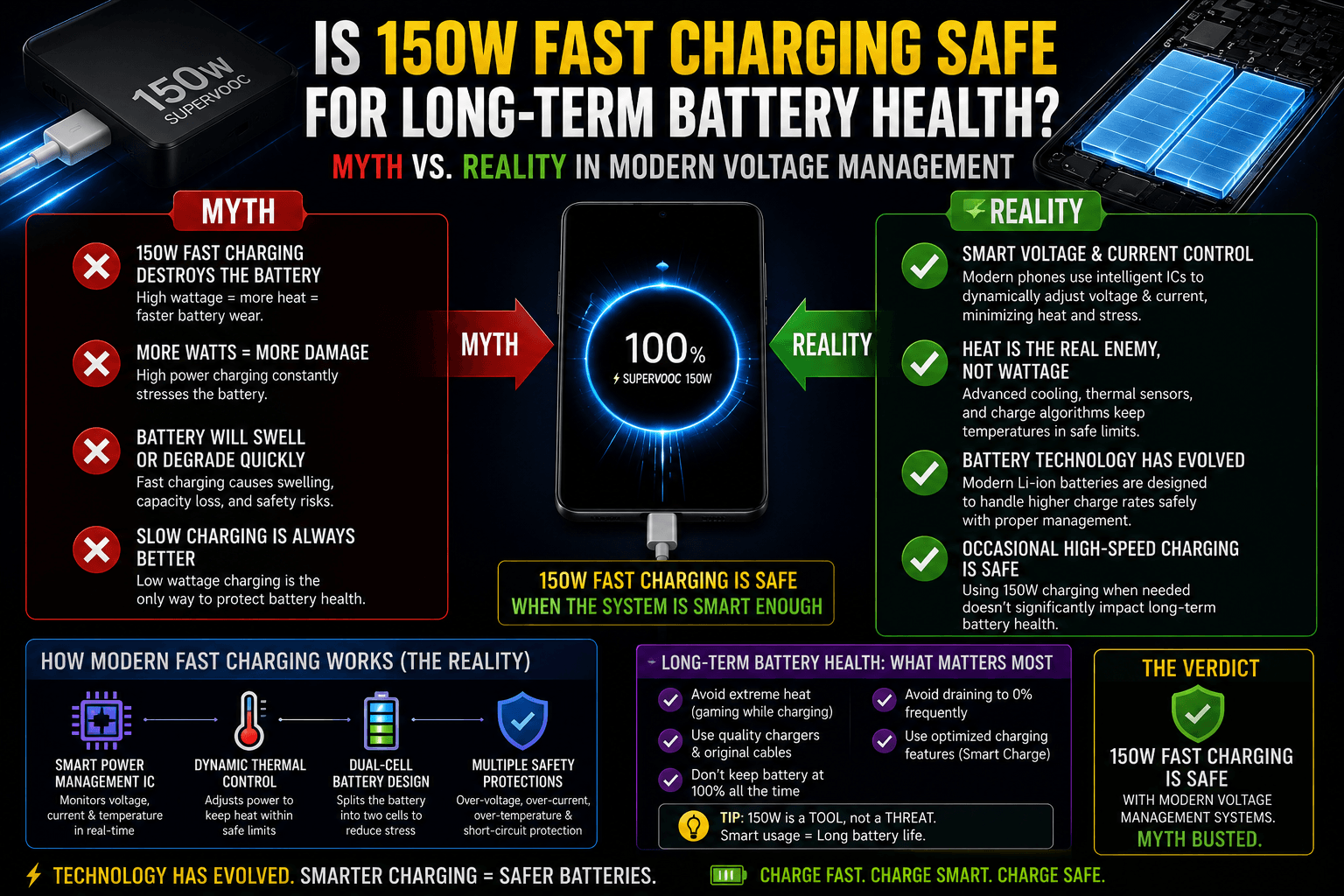
The psychological barrier to plugging a smartphone into a 150W brick is real. For years, consumer tech guidelines hammered home a strict warning: fast charging generates heat, and heat kills lithium-ion batteries. When you see a device juice up from 0% to 100% in under fifteen minutes, it is completely natural to assume that the internal chemistry is being slowly cooked.
However, the assumption that 150W speeds will destroy your battery within a year is a myth based on outdated charging mechanics.
In modern flagship smartphones, delivering triple-digit wattage safely is no longer about forcing raw power into a single cell. Instead, it relies on complex dual-cell design architectures and intelligent real-time voltage management.
The Myth: Pushing 150W Directly Into One Battery
The common misconception is that a 150W charger pushes massive, high-voltage current directly into a standard smartphone battery cell. If a manufacturer actually attempted this, the internal resistance of the battery would cause an immediate, catastrophic thermal spike, degrading the battery’s capacity within weeks.
The Reality: The Dual-Cell Architecture Split
Modern smartphones achieve 150W speeds not by charging faster, but by charging two separate batteries simultaneously.
Inside a 150W-capable phone, the battery pack is physically split into two distinct, interconnected cells (for example, two 2,500mAh cells functioning together as a 5,000mAh battery).
               [ 150W POWER SOURCE ]
                        |
                        v
             [ DUAL CHARGE PUMPS ]
            /                     \
           v                       v
  [ CELL A: 75W ]         [ CELL B: 75W ]
  (Low-Voltage / 5V)      (Low-Voltage / 5V)
When you plug in the 150W charger, the power management integrated circuits (PMICs) split the incoming current down the middle. Instead of blasting a single battery with 150W of power, the system routes 75W of power to Cell A and 75W of power to Cell B. By dividing the electrical workload, the phone stays well within safe thermal thresholds.
Moving Heat to the Wall: Smart Voltage Management
In traditional charging setups, the phone’s internal circuitry was responsible for stepping down the high voltage from the wall adapter into a usable voltage for the battery. This voltage conversion process generated significant heat directly inside the phone’s chassis, right next to the delicate battery chemistry.
Modern ultra-fast charging systems utilize Charge Pumps and an architecture called Direct Charging:
- The Smart Brick: The heavy lifting of voltage conversion is offloaded entirely to the wall brick itself. The charger communicates continuously with the phone using an encrypted protocol, adjusting the input voltage and amperage dynamically based on the battery’s real-time temperature.
- High Efficiency: By transferring the heat-generating voltage step-down process to the wall adapter, the conversion efficiency inside the smartphone reaches roughly 98%. The phone stays remarkably cool because the brick on the wall is doing the hard thermal work.
The True Culprit: The Aggressive Charging Curve
A 150W charger does not actually pump 150W of continuous power into your phone during the entire charging cycle. The peak wattage is strictly reserved for the lowest state of charge (SoC)—typically when your battery is between 0% and 30%.
As the battery fills up, the internal resistance increases, requiring the system to automatically taper the power down to prevent a phenomenon called lithium plating (where lithium ions permanently solidify on the anode, destroying battery capacity).
[ 0% - 30% SoC ]  ---> Peak 150W Speed (Emergency Top-Up Zone)
[ 31% - 80% SoC ] ---> Drops dynamically to 80W - 50W (Steady Safe Charging)
[ 81% - 100% SoC ]---> Tapers down to 15W - 5W (Trickle Charge Protection)
Longevity Metrics: What the Numbers Actually Show
Thanks to these hardware safeguards, the long-term degradation of a 150W battery is surprisingly comparable to traditional, slower charging formats.
| Charging Speed Standard | Rated Lifespan Cycles | Retained Capacity | Industry Real-World Equivalent |
|---|---|---|---|
| Old Standard 18W / 33W | ~500 Full Cycles | ~80% Capacity | 2 Years of Daily Standard Use |
| Modern 150W Dual-Cell | ~1,600 Full Cycles | ~80% Capacity | 4+ Years of Daily High-Speed Use |
Because modern fast-charging batteries use premium, high-grade chemical formulas designed to handle rapid ion movement, their structural lifespan frequently outlasts older, slower-charging battery models.
Summary: How to Maximize Your Battery Health
Is 150W charging safe? Yes. The built-in hardware safeguards ensure it won’t ruin your device. However, if you want to extend your phone’s battery health as long as possible, keep these two practical factors in mind:
- Avoid Gaming While Fast Charging: While the charger transfers conversion heat to the wall, heavy 3D gaming generates massive internal heat from the phone’s main processor. Combining heavy gaming heat with fast-charging current creates a high-thermal environment that will accelerate battery wear. www.reuz.in+ 1
- Utilize Smart Overnight Charging: If you plug your phone in right before going to bed, turn on your device’s built-in “Smart Charging” or “Battery Protection” feature. This setting caps the charge speed overnight and holds the cell capacity at 80%, only topping it up to 100% right before your morning alarm rings—preventing high-voltage structural stress.