The physical SIM card was the undisputed gatekeeper of mobile connectivity. Travelers developed a universal ritual upon landing in a foreign country: find an airport kiosk, fumble with a metal ejector tool, and swap their home carrier’s plastic chip for a local prepaid SIM. It was an analog solution to a digital problem, often resulting in lost primary SIM cards, fractured plastic trays, and localized coverage headaches.
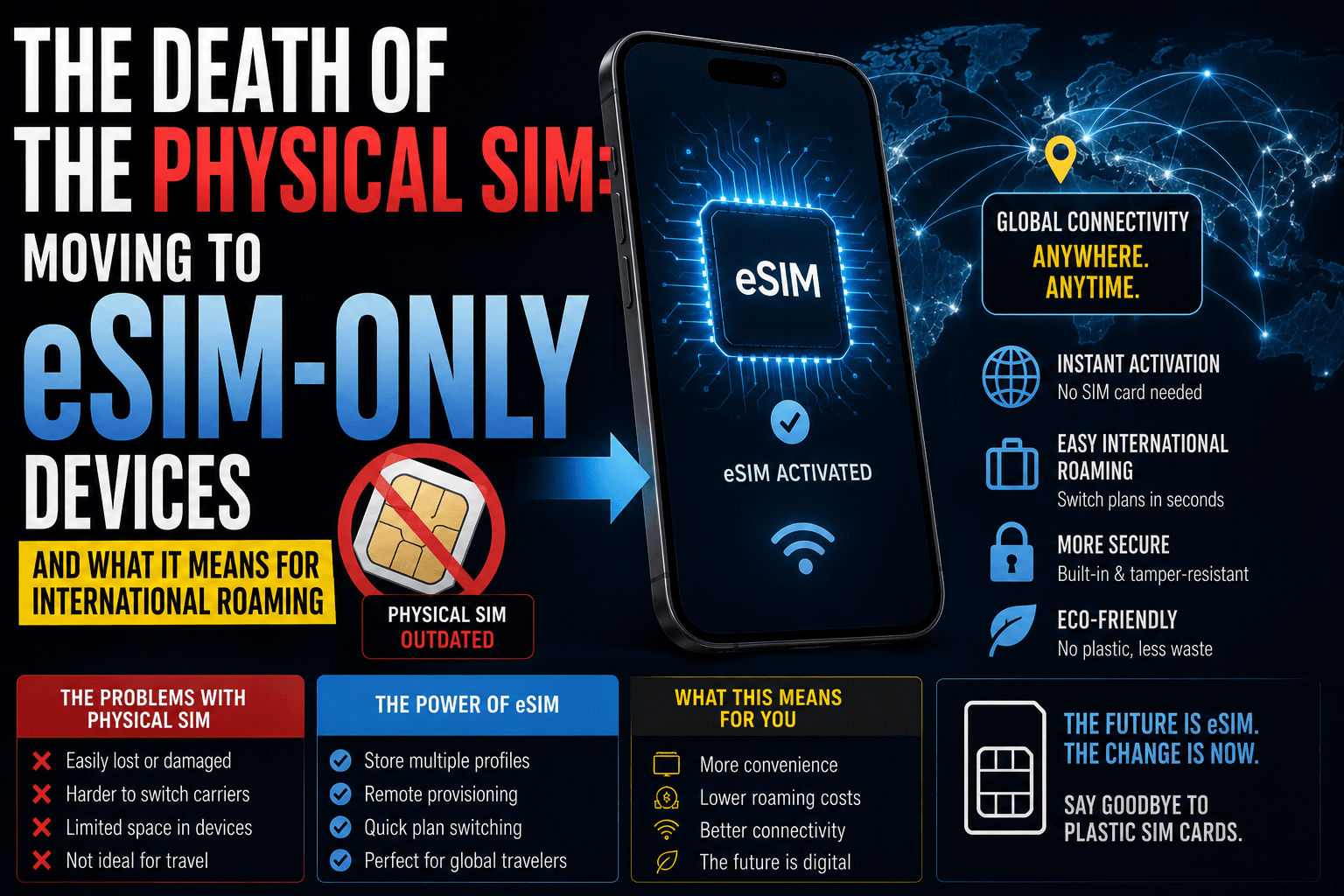
That ritual is quickly going extinct. The transition to the embedded SIM (eSIM) has graduated from an experimental secondary feature to a dominant manufacturing standard. Driven by an ecosystem moving toward eSIM-only hardware architectures, the physical SIM slot is vanishing entirely from mainstream smartphones.
This architectural shift is doing more than just altering phone designs; it is completely breaking down the traditional, highly lucrative economics of international roaming.
The Hardware Evolution: Why the Plastic Slot is Dying
From an engineering perspective, the decision to remove the physical SIM tray is a matter of optimizing internal space.
A traditional Nano-SIM card slot, along with its internal spring mechanics and external tray assembly, takes up a surprising amount of valuable real estate inside a device’s chassis. By replacing this mechanical tray with a microscopic eSIM microchip soldered directly onto the motherboard, hardware engineers reclaim crucial internal space.
  [ TRADITIONAL CHASSIS ]                [ MODERN eSIM-ONLY CHASSIS ]
+-------------------------+            +----------------------------+
| [Physical SIM Assembly] |     --->   | [Reclaimed Space for NPU,  |
| (Takes up ~10% depth)   |   REPLACED |  Larger Battery, Thermal]  |
| [Modest 4,500mAh Bat.]  |  BY MICROSCOPIC | [Massive 6,000mAh+ Bat.]   |
| [Basic Camera Sensor]   |   eSIM CHIP | [Periscope Zoom Array]     |
+-------------------------+            +----------------------------+
This structural efficiency yields immediate benefits:
- Larger Battery Capacities: Reclaimed space allows brands to pack larger battery matrices into slim device profiles.
- Advanced Thermal Design: Eliminating the hollow SIM cavity improves internal airflow and allows for larger copper vapor cooling chambers.
- Superior Environmental Sealing: A completely sealed frame with no mechanical SIM tray cutout vastly improves a device’s long-term resistance to water submersion and fine pocket dust.
The Death of “Bill Shock”: Disruption in Roaming Economics
Historically, international roaming was a major profit center for tier-one mobile network operators (MNOs). Carriers relied on bilateral roaming agreements, charging exorbitant per-megabyte rates to travelers who kept their data roaming toggled on while abroad. This dynamic birthed the era of “bill shock”—unwitting vacationers returning home to find astronomical cellular bills.
The rise of eSIM-only hardware has utterly broken this monopoly by digitizing the onboarding process. Because an eSIM profile can be downloaded instantly via software, consumers are no longer tethered to their home carrier’s expensive global packages.
The Marketplace Shift: According to data from Kaleido Intelligence, travel-specific eSIM adoption has triggered a wave of “silent roaming,” where consumers bypass traditional network operators entirely, utilizing platform-based third-party apps to secure local data rates with a few taps.
The Travel Shift: Traditional Roaming vs. Travel eSIMs
| Metric | Traditional Carrier Data Roaming | Digital Travel eSIM Marketplace |
|---|---|---|
| Average Cost | $10 per day (Flat rate structural pricing) | $1 to $3 per gigabyte (Pay-as-you-go localized utility pricing) |
| Onboarding Method | Automatic activation (Triggers high fees) | QR Code scan or instant application profile download |
| Number Management | Locks you out of your secondary local numbers | Dual-SIM active standby (Keep primary text/voice active, use local data) |
| Procurement Friction | High structural barrier to switch carriers | Immediate competitive price-comparison shopping inside digital stores |
Dual-SIM Standalone: The Ultimate Traveler Setup
One of the most powerful functional advantages of moving to an eSIM-focused architecture is the evolution of Dual-SIM Dual-Standby (DSDS) technology.
Modern premium devices allow users to store up to eight or more distinct eSIM profiles on a single device, keeping two of them actively connected to networks simultaneously.
This layout allows for the perfect structural travel setup:
- The Voice/SMS Identity: A traveler keeps their home country’s primary eSIM active exclusively for incoming phone calls, bank authorization codes, and two-factor authentication (2FA) SMS messages.
- The Data Engine: They activate a temporary, localized travel eSIM (e.g., buying a cheap 10GB localized package for Europe or Asia) and designate it as the sole data provider.
This layout completely protects the user from unexpected roaming data penalties while ensuring they never miss an important work notification or emergency communication from home.
Remaining Infrastructure Hurdles
While the software-defined future of connectivity is undeniably superior, the absolute elimination of the physical card does present localized challenges during this transitional phase.
Carrier Resistance in Emerging Markets
In regions where digital infrastructure lags, local operators have been slow to deploy remote SIM provisioning (RSP) servers. Travelers visiting remote destinations may find that while the airport kiosk sells cheap physical prepaid cards, they cannot activate them because their modern, imported smartphone lacks a physical tray slot entirely.
The Dead Phone Dilemma
If a traditional smartphone suffers catastrophic hardware damage—such as a shattered display panel or a fried motherboard—recovering your cellular identity is simple: pop the physical card out and put it into a backup phone. With an eSIM-only device, if the motherboard dies, your cellular profile dies with it. Re-activating that number requires an internet connection and security clearance from your carrier’s customer support portal, which can prove incredibly stressful when stranded abroad.
Summary: A Borderless Digital Future
The physical SIM card is joining the headphone jack and the physical keyboard in the museum of legacy mobile hardware. By transforming mobile connectivity from a physical plastic good into an on-demand software asset, eSIM technology has successfully democratized international travel. As global networks scale up automated eSIM provisioning, the borders dividing telecommunications networks will continue to fade, resulting in a truly frictionless, global mobile experience.
To see a practical walkthrough of how to set up, manage, and toggle between multiple international cellular profiles seamlessly inside a single device, watch this guide on how to deploy and configure travel eSIMs on modern devices. This video provides a step-by-step look at navigating activation screens, avoiding data-switching pitfalls, and ensuring your primary home line stays safe from unexpected carrier roaming fees.