
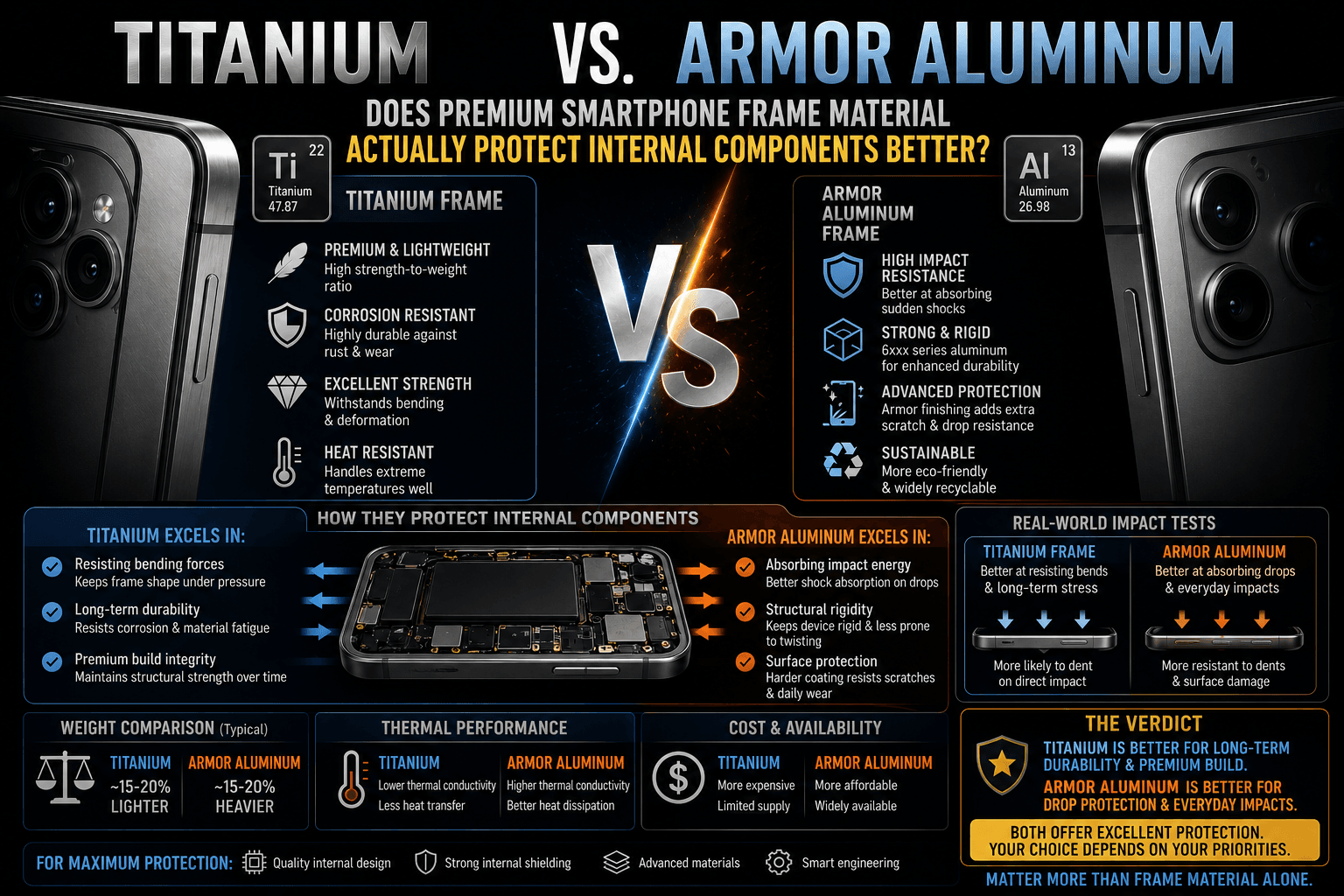
When tech giants started swapping aircraft-grade aluminum for Grade 5 Titanium, the marketing narrative was immediate: aerospace-grade durability, ultimate strength, and maximum protection. Conversely, brands utilizing specialized Armor Aluminum claim their proprietary, hardened alloys offer top-tier structural integrity without the heavy price premium.
But when a smartphone falls from pocket height onto concrete, does the choice of frame material actually offer better protection for the delicate internal hardware, like the logic board, camera sensors, and display?
The answer from mechanical engineering and repair diagnostics reveals a surprising paradox: Titanium keeps the frame pristine, but Armor Aluminum might actually save your internal components.
The Core Material Differences
To understand how these metals handle kinetic impacts, we have to look at their baseline mechanical properties. “Armor Aluminum” is typically a highly modified version of 6000 or 7000-series aluminum alloys, treated to increase hardness. Titanium used in phones is usually a titanium-aluminum-vanadium alloy (Ti-6Al-4V).
| Mechanical Property | Armor Aluminum (Typical 7000-series) | Grade 5 Titanium (Ti-6Al-4V) |
|---|---|---|
| Tensile Strength (Yield) | ~310 to 500 MPa | ~850 to 920 MPa |
| Material Hardness | ~95 to 150 HV | ~310 to 340 HV |
| Thermal Conductivity | High (~130 W/m·K) | Very Low (~6.7 W/m·K) |
| Deformation Behavior | Elastic/Plastic (Malleable) | Rigid / High Yield Limit |
The Drop Mechanics Paradox: Rigidity vs. Energy Absorption
When a phone hits the ground, a massive spike of kinetic energy enters the device. According to the laws of physics, that energy must go somewhere.
1. The Armor Aluminum Defense: Crumple Zone Physics
Aluminum is a relatively soft, malleable metal compared to titanium. When an Armor Aluminum phone drops directly onto a concrete corner, the metal dents, gouges, or deforms.
While a dent looks bad cosmetically, that mechanical deformation acts exactly like the crumple zone of a car. The metal absorbs a massive portion of the kinetic energy by physically bending, converting the shockwave into mechanical work before it can travel deeper into the phone.
2. The Titanium Defense: The Tuning Fork Effect
Titanium possesses an incredibly high yield strength; it resists bending or denting at almost three times the threshold of aluminum. When a titanium phone hits concrete, the frame usually escapes with nothing more than a superficial scratch.
However, because the rigid titanium frame refuses to bend or deform, it does not absorb the kinetic energy. Instead, the shockwave travels straight through the rigid frame and transfers directly into the next weakest links in the physical sandwich: the glass display, the delicate optical stabilization springs inside the camera sensor, and the microscopic solder joints holding the logic board components together.
The Hidden Variable: The Thermal Longevity Trade-Off
Protecting internal components isn’t just about surviving drops; it’s also about managing heat. Here, Armor Aluminum holds a massive structural advantage.
Smartphone processors and NPUs (Neural Processing Units) generate extreme heat under heavy loads, like 4K video recording or intensive gaming. If that heat isn’t dissipated, it causes long-term thermal degradation of the lithium-ion battery and internal silicon chips.
- Aluminum acts as an exceptional heat sink. It draws thermal energy away from the processor and dumps it out through the exterior frame of the device quickly.
- Titanium is an incredibly poor thermal conductor (roughly one-sixth the efficiency of aluminum). Because a pure titanium band traps heat, manufacturers are forced to bond a thin titanium exterior band to an internal aluminum mid-frame using solid-state diffusion. Even with this hybrid layout, titanium-framed phones typically run warmer internally during sustained workloads, placing greater long-term thermal stress on the battery.
Summary: Which Material Protects Better?
If your goal is to protect the smartphone’s internal hardware and longevity, the choice between the two materials comes down to a clear technical divide:
- Choose Armor Aluminum if you prioritize internal component safety and heat management. It acts as a natural shock absorber during drops and keeps internal operating temperatures lower, even if the exterior frame shows cosmetic scuffs and dents more easily over time.
- Choose Titanium if you prioritize exterior cosmetic preservation and long-term frame rigidity. It ensures your phone will never bend or warp under torsional pressure (like sitting on it in a pocket) and resists structural fatigue for years, though you will rely heavily on internal software damping and advanced glass formulations to survive sudden impact shockwaves.
Ultimately, repair diagnostics consistently show that a phone’s structural frame material matters far less than a high-quality protective case. No matter how strong the metal rail is, a case with integrated air pockets remains the most effective tool to stop destructive kinetic energy from reaching your phone’s fragile internal components.