For decades, connecting a phone to a satellite required specialized, expensive hardware—devices with thick, protruding antennas, heavy battery packs, and proprietary software designed to lock onto massive satellites orbiting thousands of kilometers away. If you took a standard, off-the-shelf smartphone into a deep mountain canyon or an offshore dead zone, it became an expensive paperweight.
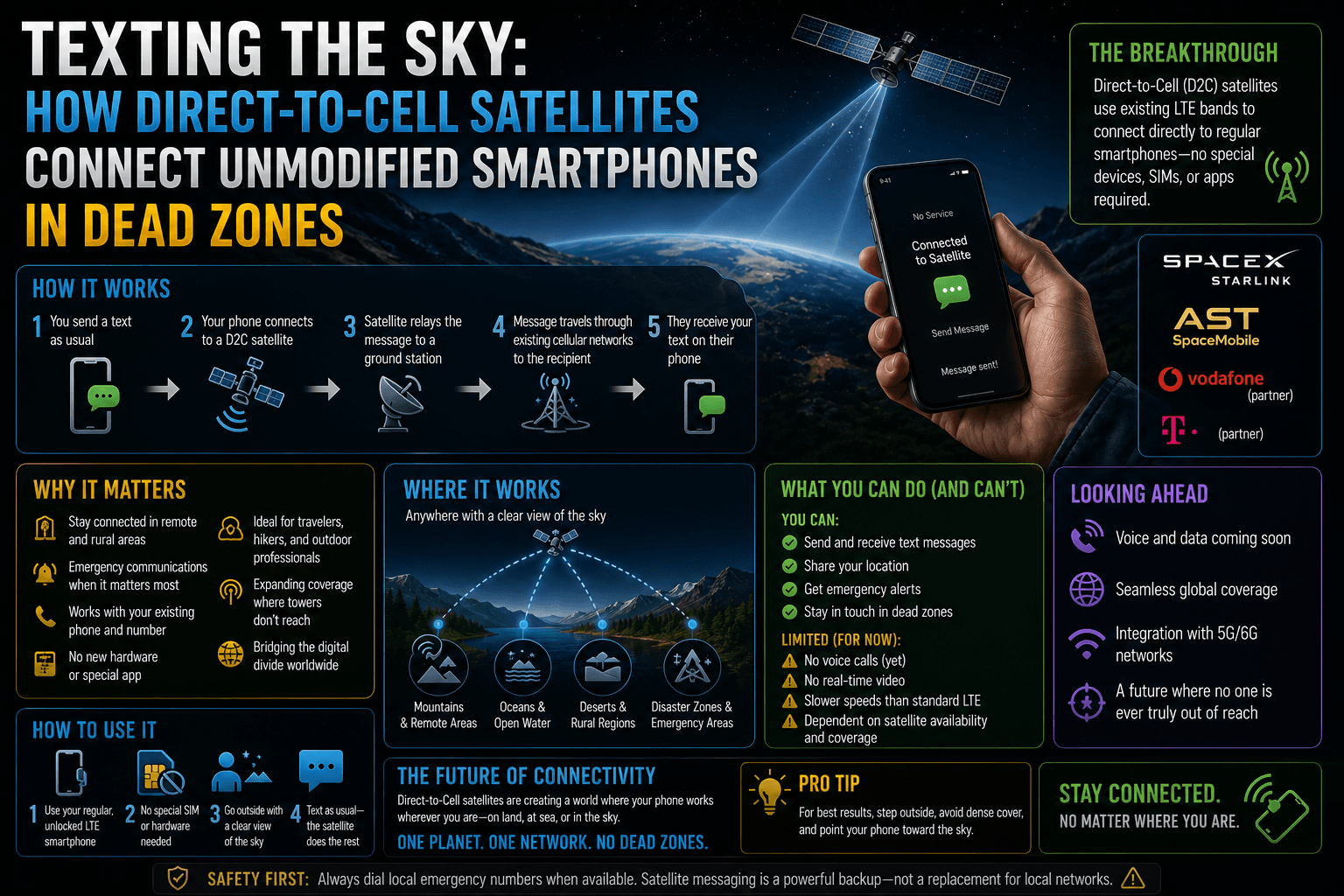
That barrier has officially broken. Major cellular carriers and satellite networks have scaled Direct-to-Cell (DTC) technology. Standard, unmodified LTE and 5G smartphones can now connect directly to overhead satellite constellations, dropping text messages, location coordinates, and data packets from places where traditional cell towers can’t reach.
The engineering behind this shift requires overcoming massive physical constraints. Here is how space-bound infrastructure mimics a cell tower to talk to the phone in your pocket.
1. The Core Engineering Challenge: The “Loudspeaker” Problem
Connecting a standard smartphone to a satellite is fundamentally a physics problem involving distance and power. Traditional cell towers sit stationary on the ground, usually within 2 to 15 kilometers of your device. Low Earth Orbit (LEO) satellites, by comparison, scream through space at roughly 27,000 km/h at an altitude of 350 to 600 kilometers.
To make matters more complex, a standard smartphone possesses an incredibly small omnidirectional antenna and operates on a tiny power budget (typically less than 2 watts when transmitting).
To bridge this massive gap, satellite operators had to fundamentally redesign space hardware to solve two critical bottlenecks:
+------------------------------------------------------------+
|                       LEO Satellite                        |
|  - Massive Phased Array Antennas (Gigantic "Ear trumpet")  |
|  - Custom Silicon / Advanced DSP (Cancels Doppler Shift)   |
+------------------------------------------------------------+
                             │
                             │  ~500 km through space
                             ▼
+------------------------------------------------------------+
|                 Unmodified LTE/5G Phone                    |
|  - Low Antennal Gain (Internal)                            |
|  - Low Power Output (~2W max)                              |
+------------------------------------------------------------+
- Massive Phased Array Antennas: Because the smartphone’s transmitter is weak, the satellite’s receiver must be incredibly sensitive. Next-generation DTC satellites deploy massive, folding phased array antennas that act like giant electronic ear trumpets, isolating and magnifying the tiny, faint signals coming from consumer phones on the ground.
- Doppler Shift Compensation: Because the satellites are moving so quickly relative to the person standing on Earth, the radio frequencies experience severe Doppler shift (the stretching or compression of radio waves as the source moves). Custom on-board silicon and advanced digital signal processing (DSP) dynamically warp the space-bound frequencies in real-time, tricking the phone into thinking it is talking to a stationary ground tower.
2. The Tech Stack: How the Connection Protocol Works
Unlike proprietary satellite communication networks of the past, modern Direct-to-Cell technology utilizes standard terrestrial cellular spectrum. Instead of forcing phone manufacturers to install specialized chips, satellite constellations broadcast down using standard LTE protocols via partnerships with local cellular carriers (such as T-Mobile in the US, Optus in Australia, or Rogers in Canada).
When your phone loses connection to ground-based infrastructure, it executes a seamless background handoff:
1. Terrestrial Signal Drop: Automatic.
The smartphone moves out of range of local cell towers. The device begins scanning all accessible radio bands for an active network identity code.
2. Satellite Network Discovery: LTE/5G Roaming.
An overhead LEO satellite broadcasts standard LTE signals down to Earth using partner carrier frequencies. Your phone intercepts this signal and recognizes it as an available network (displaying names like “T-Sat+Starlink” or “Satellite” in your status bar).
3.Handshake & Authentication:3GPP NTN Standards.
The phone sends an authentication request upward. The satellite acts as a transparent relay, passing this packet down to a terrestrial ground station, which validates your SIM card permissions through your carrier’s home network.
4. Low-Bandwidth Pipeline Open: Active Connection.
Once authenticated, a highly optimized, low-bandwidth data pipeline is opened. The user can now transmit SMS, MMS, RCS, and location payloads natively.
3. The Current Capabilities: What Can You Actually Do?
Because space-to-ground bandwidth is a shared, constrained resource, you cannot stream 4K video or download massive files over a standard DTC link. Instead, the infrastructure is optimized to prioritize highly compressed text and telemetry packets.
| Feature / Utility | Current Status | Performance / Optimization |
| Text Messaging (SMS/RCS) | Fully Operational | Native integration via default messaging apps; supports emergency and standard peer-to-peer texts. |
| Optimized App Integration | Expanding | Select low-bandwidth apps (e.g., WhatsApp, Google Maps, AllTrails, AccuWeather) are optimized to send compressed data packets. |
| Live Location Sharing | Fully Operational | Allows outdoor adventurers to broadcast real-time GPS telemetry back to family or emergency dispatchers. |
| Voice & High-Speed Data | In Development | Constellation sizes and power allowances are currently scaling up to support reliable real-time voice calls. |
4. Why These Changes Affect Wilderness Safety and Global Logistics
The implications of turning every consumer phone into a dual terrestrial-satellite device are profound. It effectively eliminates the concept of a true “cellular dead zone” across habitable landmasses and coastal waters.
The Emergency Safety Net: Historically, getting lost or injured in a remote national park meant relying on a dedicated satellite messenger device. With DTC systems active, anyone with an ordinary smartphone can text emergency services (Text-to-911) for free, regardless of whether they have a paid satellite subscription or an active cellular contract.
Beyond consumer safety, this architecture completely alters remote industry operations. Field researchers, maritime workers, and long-haul logistics fleets can maintain persistent text and telemetry coordinates using standard mobile hardware, bypassing the need to deploy dedicated, expensive satellite terminals across entire workforces.
The Evolution of the Horizon
As satellite operators secure regulatory approvals to operate at higher power thresholds and launch thousands of higher-capacity spacecraft, the line between space-based and ground-based networks will continue to blur. Your phone will simply connect to whatever is closest—whether that is a tower on a nearby ridge or a satellite passing hundreds of kilometers overhead.