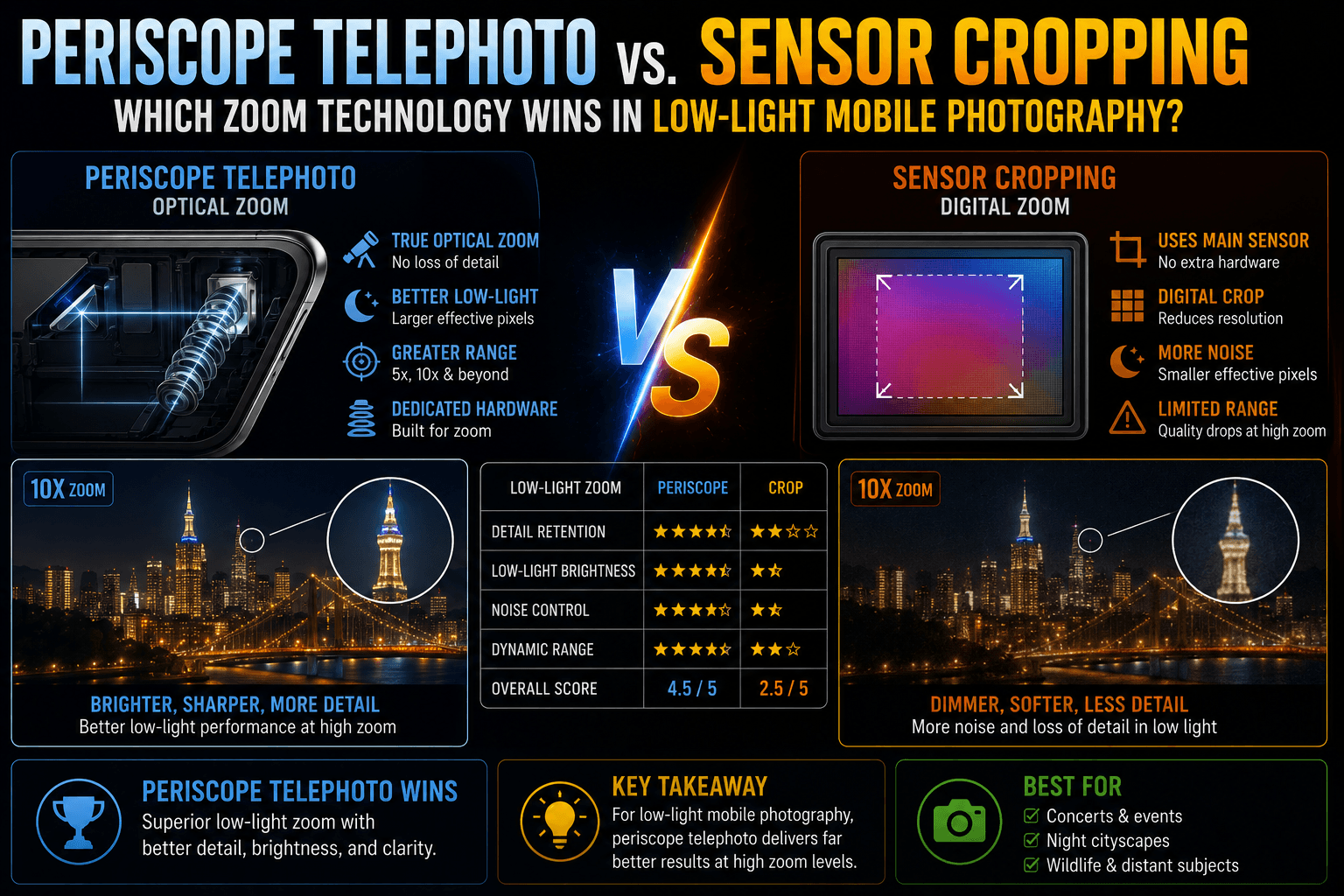
For years, zooming in with a smartphone camera meant accepting a massive drop in image quality. Today, mobile manufacturers use two radically different engineering strategies to bring faraway subjects closer: physical Periscope Telephoto lenses and software-driven In-Sensor Cropping (also known as lossless sensor crop).
While both techniques produce sharp, detailed results under broad daylight, low-light photography is the ultimate equalizer. When the sun goes down, the physics of light capture takes over.
If you are shooting at night or in dimly lit indoor spaces, understanding how these two technologies behave will completely change your mobile photography results.
1. The Periscope Telephoto: Dedicated Optical Reach
A periscope camera uses a folded optics layout to bypass the physical thickness limits of a thin smartphone. Instead of pointing the camera lens elements straight out of the back of the phone, a prism bends incoming light by 90 degrees, bouncing it horizontally through a series of internal lenses onto a vertically oriented sensor.
       [ PERISCOPE OPTICS LAYOUT ]
Light ---> [Prism] ---> [Moving Lens Elements] ---> [Camera Sensor]
This structural trick delivers true 5x or 10x optical magnification. However, this extended physical path introduces distinct challenges for low-light shooting:
- Light Loss Across the Prism: Every time light bounces off a mirror or passes through dense glass elements, a small percentage of photons is lost.
- Narrower Apertures: Because the lens assembly must remain tiny to fit inside a phone frame, periscope modules typically have narrower apertures (frequently ranging from f/2.6 to f/4.0). A narrower aperture physically chokes the amount of light hitting the sensor.
- Smaller Sensors: Due to the horizontal layout constraints, the sensors paired with periscope lenses are traditionally quite small (often 1/2.51-inch or smaller), meaning smaller individual pixels that struggle to capture light in the dark.
2. Sensor Cropping: Leveraging the Raw Power of the Main Lens
In-sensor cropping takes an entirely different approach. Rather than relying on a separate, dedicated zoom lens, it uses the phone’s primary wide-angle camera, which features the largest, most advanced sensor on the device (often up to 1-inch in size) and a massive resolution (50MP to 200MP).
To achieve a “lossless” 2x or 3x zoom, the camera software bypasses standard digital magnification. Instead, it crops directly into the center-most 12 megapixels of the high-resolution sensor, outputting a native, un-interpolated 12MP image file.
[         50MP MAIN SENSOR AREA         ]
|                                       |
|          +-----------------+          |
|          |  12MP CROP AREA |          |  ---> Lossless 2x/3x Zoom
|          +-----------------+          |
|                                       |
+---------------------------------------+
- Massive Light Gathering Capabilities: Because this technique utilizes the main camera, it inherits the primary lens’s exceptionally wide aperture (usually between f/1.4 and f/1.8). An f/1.4 lens lets in over four times as much light as a periscope’s f/3.0 lens.
- Advanced Sensor Tech: Main sensors feature superior dynamic range, faster autofocusing systems, and advanced anti-glare coatings that secondary periscope sensors lack.
The Low-Light Showdown: Which Tech Wins?
The winner depends entirely on your exact zoom distance. The physics of mobile photography creates a distinct performance crossover point.
| Zoom Range | Low-Light Winner | Technical Breakdown |
|---|---|---|
| 1.1x to 3x Zoom | Sensor Cropping | The main sensor’s wider aperture and superior physical surface area capture far more ambient light. Images feature significantly lower digital noise, better color accuracy, and less motion blur. |
| 5x Zoom and Beyond | Periscope Telephoto | At 5x range, a main sensor crop must pull from an incredibly tiny cluster of pixels, degrading the image into blurry digital noise. Even with a narrow aperture, the periscope’s true optical magnification captures genuine structural detail that software cannot replicate. |
The Crossover Trap: Most modern smartphones are programmed to automatically override your manual camera settings in low light. If you select the “5x” zoom option in a dark room, the phone’s software will often secretly reject the periscope lens entirely. It defaults back to a crop on the main sensor because the algorithm calculates that the main lens can gather more usable light, even if it means sacrificing fine structural detail.
Summary: Designing Your Night Shots
For optimal low-light smartphone photography, adapt your position to match your phone’s hardware strengths:
- If you are shooting at close-to-medium range (Portraits, indoor venues, street photography): Keep your zoom toggle between 1x and 3x. Let the main sensor crop handle the shot to maximize light gathering and eliminate grainy image noise.
- If you absolutely must capture a distant subject (Concert stages, architecture, wildlife): Force your device to use its Periscope lens, ensure you have a completely stable hand or a tripod, and let the camera’s dedicated Night Mode run a long exposure cycle to compensate for the narrow aperture.
To see a direct, real-world comparison of these two zooming methods analyzed under variable lighting conditions, watch this comprehensive Smartphone Camera Sensor Crop vs Optical Telephoto Zoom Deep Dive. This technical analysis breaks down side-by-side photo samples, digital noise charts, and sensor performance metrics across current flagship devices.