For decades, satellite communication required specialized, bulky hardware equipped with massive external antennas. If you stepped outside the boundaries of cellular coverage, you were completely cut off unless you carried a dedicated satellite messenger or satphone.
A quiet technological revolution has unfolded within modern mobile devices. Standard, off-the-shelf smartphones can now establish direct communication links with satellites orbiting hundreds of kilometers above the Earth.
When you send an emergency SOS text or a routine message from the middle of a desert, an ocean, or a remote mountain range, your phone executes a highly precise hardware and software orchestration to bridge the gap without a traditional cell tower in sight.
1. The Architectural Split: NTN vs. Direct-to-Cell
To make satellite texting work on a standard smartphone, the telecommunications industry has deployed two distinct architectural pathways.
The NTN Framework (Dedicated Satellite Chips)
The Non-Terrestrial Network (NTN) standard relies on specific hardware modems built into your smartphone (such as Apple’s custom wireless chips or Qualcomm’s Snapdragon Satellite architecture).
- The Connection Path: These modems are tuned to communicate with dedicated satellite constellations operating in specific, authorized frequency spectrums (like Globalstar or Iridium).
- The Technical Catch: Because standard smartphones have tiny, internal antennas, you cannot just text from your pocket. You must be completely outdoors with an unobstructed view of the sky, and you must hold the phone steady, pointing it directly at a passing satellite guided by an on-screen software visualizer.
The Direct-to-Cell Framework (Standard LTE Roaming)
The second approach involves constellations (like SpaceX’s Starlink Direct-to-Cell or AST SpaceMobile) deploying massive, highly advanced phased-array antennas into space.
- The Connection Path: These spaceborne antennas are so powerful and sensitive that they can mimic a standard, ground-based cellular tower.
- The Technical Catch: Your phone doesn’t need a special satellite chip or a custom application; it treats the satellite as a standard roaming cell tower. It broadcasts a normal LTE text signal over existing terrestrial frequencies. While slower and lower-capacity than ground networks, it allows seamless text message fallback on unmodified devices.
2. Tracking the Orbit: LEO vs. GEO Satellite Networks
The speed and reliability of your off-grid message depend entirely on the type of satellite constellation your phone provider utilizes.
+------------------------------------+------------------------------------+
| LEO Constellations (Starlink/Apple)| GEO Constellations (Inmarsat)      |
+------------------------------------+------------------------------------+
| • Altitude: 500 km – 1,200 km      | • Altitude: ~35,786 km             |
| • Low Latency (Near Real-Time)     | • High Latency (Long Delays)       |
| • Satellites zip across the sky    | • Fixed relative to Earth's surface|
| • Requires a web of thousands      | • Needs just 3-4 for global coverage|
+------------------------------------+------------------------------------+
[Image comparing the orbital altitude and signal paths of Low Earth Orbit LEO) vs. Geostationary GEO satellites communicating with a smartphone]
Low Earth Orbit (LEO)
Most consumer smartphone satellite services utilize LEO networks. Because these satellites circle the globe just 500 to 1,200 kilometers up, the physical distance your wireless signal has to travel is relatively short. This enables remarkably fast text transmission times (often under 15 to 30 seconds under a clear sky) because the radio waves face less atmospheric degradation.
Geostationary Orbit (GEO)
Traditional satellite communication relies on GEO satellites parked over 35,000 kilometers away. Because they match the Earth’s rotation exactly, they appear completely stationary in the sky. While excellent for broad, continuous coverage, the extreme distance introduces noticeable transmission delays, requiring significantly more transmission power than a standard smartphone battery can safely push.
3. The Execution Pipeline: How a Single Text Travels Through Space
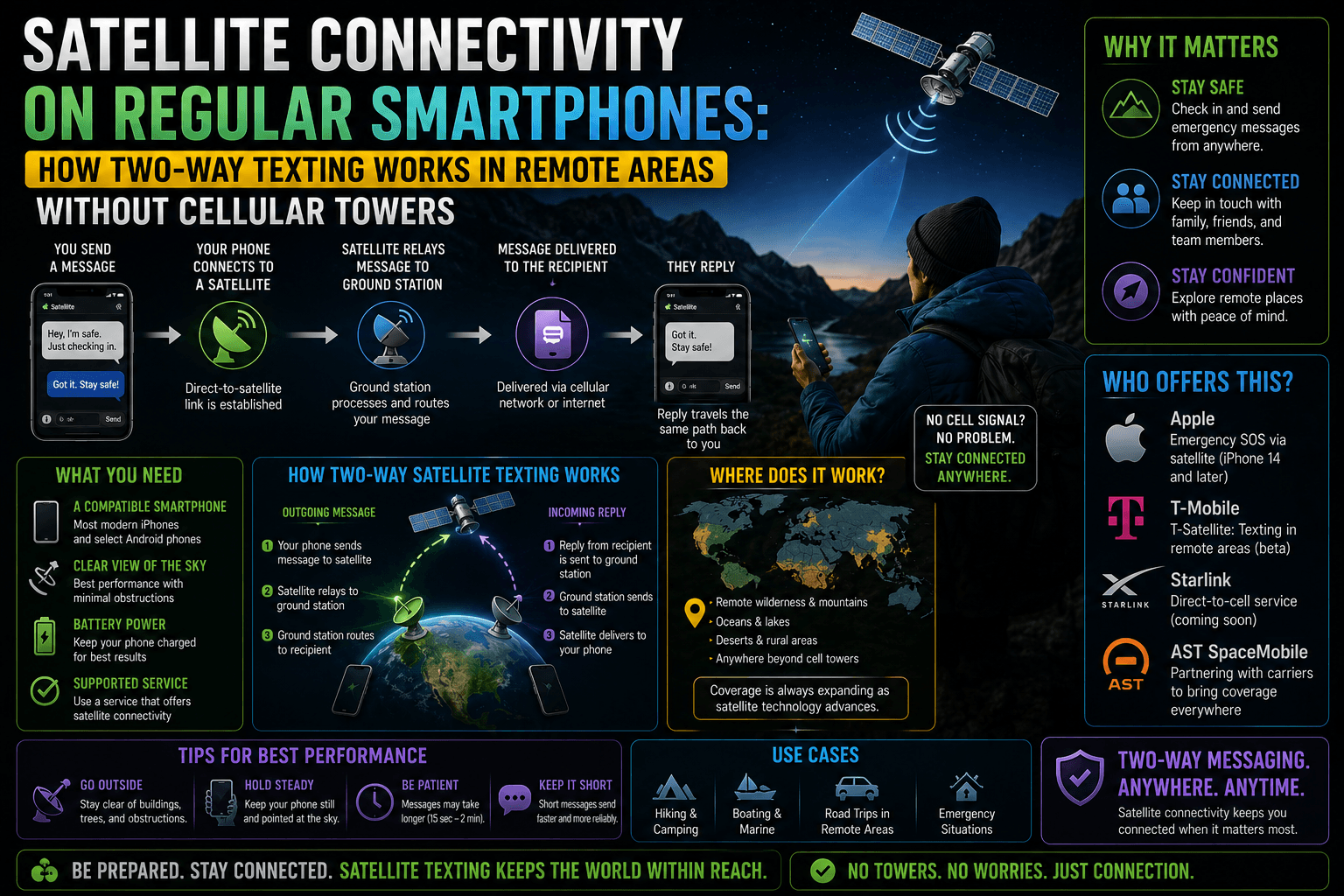
When you type a message in a cellular dead zone, the text undergoes a complex, multi-stage relay to reach its destination:
1
Data Compression and Packetization
Compressing the footprint
- Data Compression and Packetization: Compressing the footprint.
Because satellite bandwidth is heavily constrained, your phone aggressively strips down the text message. It removes rich metadata, emojis, and media formatting, condensing the text into an ultra-lean, lightweight data packet.
2
The Uplink Handshake
Line-of-sight targeting
2. The Uplink Handshake: Line-of-sight targeting.
The phone’s software guides you to point the device at an active satellite. The internal modem fires a targeted radio frequency pulse upwards, bridging the hundreds of kilometers separating your hand from the satellite’s receiver array.
3
The Satellite Downlink Intercept
The space-to-ground bounce
3. The Satellite Downlink Intercept: The space-to-ground bounce.
The orbital satellite receives your packet and immediately mirrors it back down to Earth, targeting a massive, high-throughput ground base station known as a Gateway.
4
The Core Network Route
Final terrestrial delivery
4. The Core Network Route: Final terrestrial delivery.
The ground gateway decrypts the packet and injects it into the standard terrestrial telecom infrastructure. If it is an emergency message, it hits local emergency response dispatch networks; if it is a casual text, it is routed straight to the recipient’s standard cell network.
4. Hardware Limitations: Why You Can’t Stream Video via Satellite Yet
While the ability to text from a remote canyon is revolutionary, physics dictates strict limitations on consumer satellite features:
- Extreme Bandwidth Bottlenecks: A satellite pass might only provide a total data throughput equivalent to an old dial-up internet connection shared across an entire geographical region. This is why providers strictly limit usage to short text strings and completely block image, video, and voice data transmission.
- The Battery Drain Trap: Pushing a radio signal clean through the Earth’s atmosphere requires a sustained burst of power from your phone’s transceiver. Using satellite connectivity continuously causes rapid battery drain and can cause the back of your smartphone to warm up significantly.
- Weather and Canopy Blockades: Dense forest canopies, heavy rainstorms, thick winter cloud cover, and urban high-rise buildings can scatter or absorb the fragile microwave frequencies used for satellite communication, causing messages to fail or take minutes to slip through.
The Backcountry Golden Rule: Satellite connectivity on regular smartphones is a pahenomenal safety net, but it should never replace a dedicated, high-power satellite messenger (like a Garmin InReach) if you are embarking on true wilderness expeditions. Treat your phone’s satellite feature as an incredible emergency backup, and always verify your provider’s active satellite coverage maps before stepping past the boundary of the grid.