
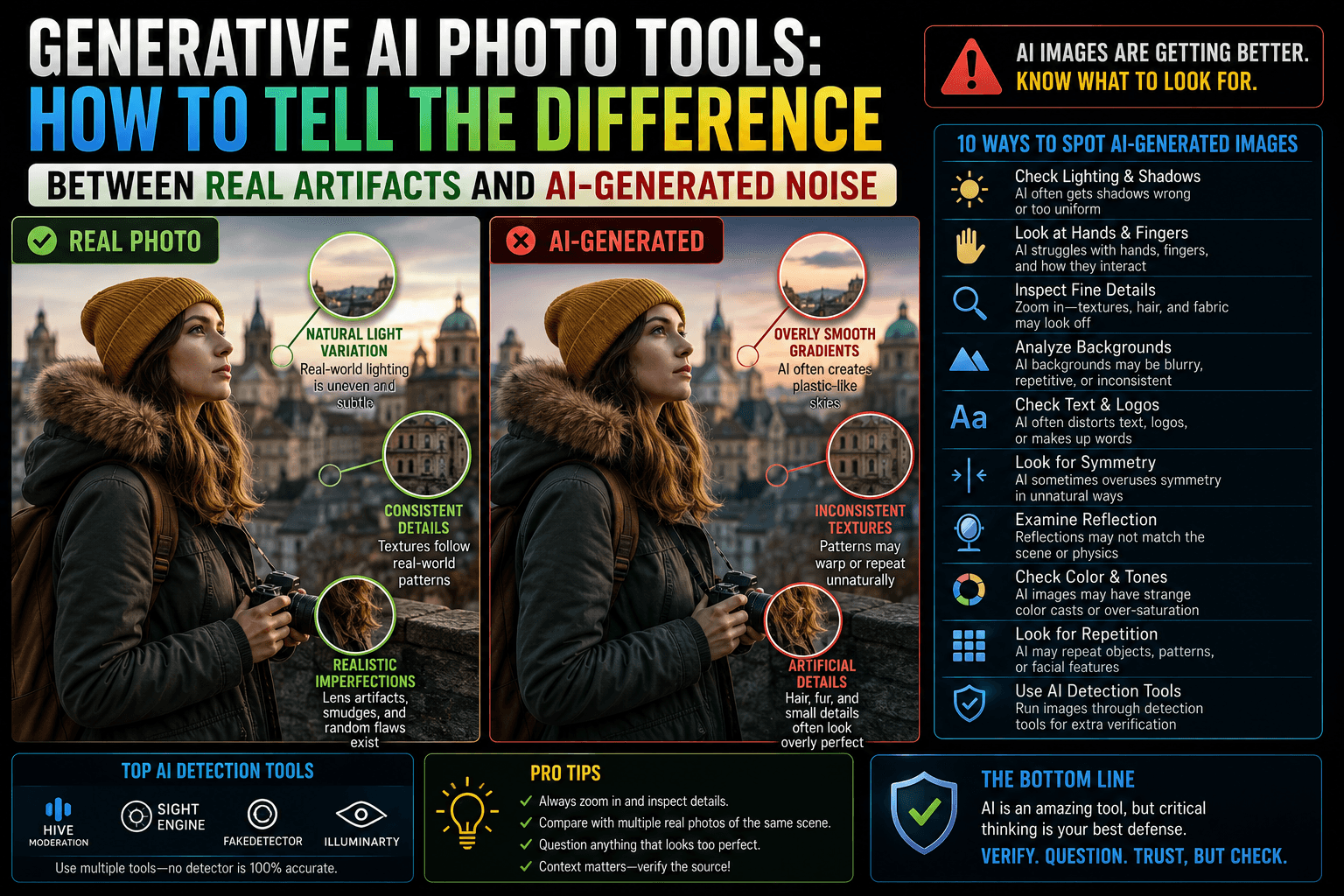
Modern image generators—like Midjourney, Flux, and DALL-E—produce breathtakingly photorealistic results. However, because these tools generate images by predicting pixel patterns rather than understanding the laws of physics, they leave behind specific “fingerprints.”
When determining if an image is an authentic photograph or a synthetic creation, zooming in reveals a clear dividing line. Authentic cameras introduce natural photographic artifacts and sensor noise, whereas AI tools create mathematical generation noise and texture smoothing.
Sorting the real from the synthetic requires knowing exactly how these pixel-level structures behave under microscopic inspection.
1. Pixel-Level Analysis: Digital Noise vs. AI Smoothing
Every authentic digital photograph captured by a physical camera sensor contains a baseline layer of imperfection. AI images lack this natural physics-based foundation, resulting in a completely different pixel landscape when you zoom in to 200% or 400%.
Real Sensor Noise (Grain)
When light hits a physical camera sensor, variations in electricity and temperature create digital noise.
- The Visual Signal: In low light or at high ISO settings, this presents as sharp, granular, monochromatic, or color-speckled “grain” distributed uniformly across the image.
- The Forensic Reality: This noise is sharp and sharp-edged at the pixel level because it is generated by the physical hardware layout of the sensor grid.
AI Generation Noise
Diffusion models work by taking a field of random digital static and progressively refining it over dozens of steps into a coherent image.
- The Visual Signal: Instead of sharp, uniform grain, AI images often display a distinct “waxy sheen” or “plastic texture”.
- The Forensic Reality: Because the AI model is mathematically trying to “blend” pixels together to form an optimal shape, it creates unnatural color transitions at object edges, sudden patches of hyper-smooth rendering, or a uniform background blur that looks like it was brushed on with a digital airbrush rather than created by a true physical camera lens (depth of field).
2. Forensic Artifacts Matrix: Real vs. Synthetic
Beyond basic noise, the structural discrepancies between how a camera captures reality and how an AI engine hallucinates reality can be broken down across key indicators:
| Forensic Feature | Authentic Camera Artifacts | AI-Generated Inconsistencies |
|---|---|---|
| Edge Transitions | Sharp, crisp geometric separation based on optics; uniform color fringing (chromatic aberration) may occur near high-contrast edges. | Abnormal, smudged, or “bleeding” color boundaries where two distinct objects or textures blend into one another. |
| Image Compression | Standard, repeating blocks of 8×8 pixels (JPEG artifacts) uniformly distributed across the entire frame. | Uneven compression distribution; certain complex regions (like a face) may be ultra-sharp, while adjacent empty spaces feature heavy compression anomalies. |
| Specular Reflections | Reflections on shiny surfaces perfectly align with the environment; catchlights in both left and right eyes match the identical light source. | Irregular reflections that display a different environment from the scene; mismatched catchlights in human eyes (e.g., a square light in one eye, a circular light in the other). |
| Geometric Textures | Micro-textures like clothing fabric patterns, brick mortar lines, or fence grids maintain structural, repeating uniformity. | Repeating patterns suddenly “melt,” twist, or lose structural logic as they span across a surface. |
3. The Structural Check: Spotting Violations of Physics
Because text-to-image AI models are trained on pixel data rather than structural logic, they fundamentally fail to grasp how objects interact in three-dimensional space. To verify authenticity quickly, trace the geometry of the scene:
Trace the Light and Shadow Vectors
Identify the primary illumination.
1 . Trace the Light and Shadow Vectors: Identify the primary illumination.
Locate the dominant light source in the scene. Trace an imaginary line from that light source, past the subject, to their shadow. In AI images, shadows frequently wrap around objects incorrectly, point toward the light source, or project at impossible angles.
Map Geometric Convergence Lines
Evaluate intersecting lines
2.Map Geometric Convergence Lines: Evaluate intersecting lines.
Look for straight structural lines in the background—such as window frames, handrails, or architectural pillars. Trace their paths. AI generation often introduces subtle warping, causing solid lines to bend, shift levels unexpectedly, or to enter impossible perspective vanishing points.
Inspect Functional Interactions
Verify user interaction
3. Inspect Functional Interactions: Verify user interaction.
Look closely at where the human body interacts with an object. Check if fingers seamlessly melt into coffee mugs, if backpack straps pass directly through clothing layers, or if clothing buttons are placed asymmetrically to their buttonholes without physical alignment.
4. The 2026 Verification Landscape: Software Solutions
As commercial image generators become increasingly sophisticated, human visual analysis alone is becoming less reliable. Security systems and forensic teams are shifting away from trying to find visual mistakes, choosing instead to focus on cryptographic proof.
The Limits of AI Detectors
While online automated classification engines (like Hive Moderation or Sightengine) use machine learning algorithms to scan for hidden statistical patterns in pixel structures, their accuracy rates fluctuate. Recent benchmarks reveal that modern commercial generators (such as Flux Dev) can confuse standard detectors, occasionally causing them to misidentify real, high-resolution photographs as synthetic content.
The Rise of C2PA Content Credentials
The most foolproof method for verifying a real photograph is Provenance Certification. Under the global C2PA standard, modern cameras and smartphone processors can cryptographically sign an image file at the exact millisecond the physical shutter clicks.
This secure, tamper-evident metadata packet stays attached to the file as “Content Credentials.” If the photo is later altered using a generative AI cleanup tool, edited in Photoshop, or completely fabricated from text, the public cryptographic chain breaks—instantly tipping off platforms and viewers that the image is no longer an untampered, authentic photograph.
The Evaluator’s Checklist: When auditing an image, always start with macro context (sociocultural logic), drop down to mid-tier geometry (shadows, text legibility, and reflections), and finally zoom to the micro-pixel level. If you find a complete absence of granular digital noise alongside waxy skin and blended boundaries, you are looking at a synthetic AI calculation.